Q21 · 9701/41/O/N/25 Q8
Worked solution from the Carboxylic acids and derivatives Theory (Paper 4) booklet, Part 2 of 2.

Worked solution
(a)(i)
Write: NO2 directs to the 3 (and 5) / meta position because it is an electron-withdrawing group. [1]
(a)(ii)
Write HNO3 + H2SO4 → NO2+ + HSO4− + H2O [1]
(b)(i)
Q has an acyl group and an isopropyl group. Compound P is the first product, from the first reaction. Draw phenylethanone, C6H5COCH3. [1]
(b)(ii)
Both steps are Friedel–Crafts reactions. Because the acyl group directs meta, the acyl group goes on first.
Reaction 1: write CH3COCl with AlCl3. [1]
Reaction 2: write 2-bromopropane, (CH3)2CHBr, with FeBr3. [1]
(c)
Observations: C6H5Br gives no change (no precipitate), and C6H5CH2Br gives a cream precipitate. [1]
In C6H5Br, a lone pair (p-orbital) on Br overlaps with the π system of the ring. [1]
This makes the C–Br bond stronger (partial double bond character), so Br− is not released. [1]
(d)(i)
Write (nucleophilic) addition–elimination. [1]
(d)(ii)
Water attacks the C of C=O, then Br leaves.
Any two of these points = 1 mark, all four = 2 marks: lone pair on O of H2O; curly arrow from the O lone pair to the C; correct δ+ and δ− on C=O; curly arrow from the C=O bond to the O. [2]
Intermediate: C bonded to R, Br, O− (with lone pair) and +OH2. [1]
Curly arrow from the O− lone pair to the C–O bond, and a curly arrow from the C–Br bond to Br. [1]
Official mark scheme

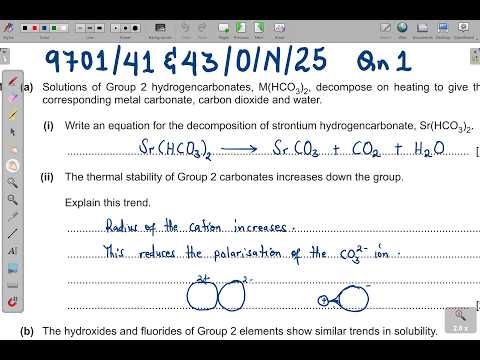 ▶ Whole paper
Video solution of the whole paper · by THE A* CHEMISTRY SOLDIER. Tap the picture to open it on YouTube.
Solutions follow the official Cambridge mark schemes; marks are shown in grey. Videos are from other YouTube channels. Paper codes read component / series / year: M/J = May/June, O/N = October/November. Past-paper questions © UCLES, reproduced for classroom practice.