Q49 · 9706/41/M/J/23 Q2
Worked solution from the Cost and management accounting (A Level) Theory (Paper 4) booklet, Part 3 of 4.

Worked solution
(a)
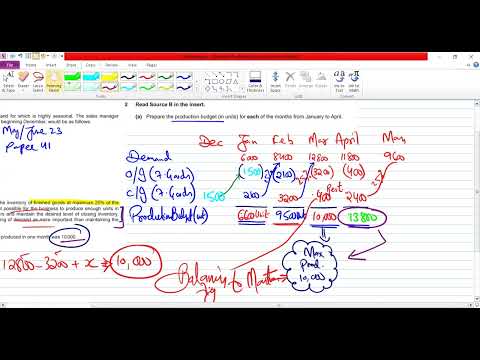
Closing inventory target = 25% of next month's sales. Production = sales + closing inventory − opening inventory, but production cannot pass 10 000 units, and meeting demand matters more than closing inventory.
Opening inventory in January = 25% × January sales 6 000 = 1 500 (December's closing).
January: closing = 25% × 8 400 = 2 100; production = 6 000 + 2 100 − 1 500 = 6 600. February: closing = 25% × 12 800 = 3 200; production = 8 400 + 3 200 − 2 100 = 9 500. March: 12 800 + 2 950 − 3 200 = 12 550 is above the 10 000 limit, so produce 10 000 and closing inventory is 3 200 + 10 000 − 12 800 = 400. April: only 400 + 10 000 = 10 400 units can be sold, so sales are 10 400 (not 11 800) and closing inventory is 0.
| Details (units) | January | February | March | April |
|---|---|---|---|---|
| Opening inventory | 1 500 | 2 100 | 3 200 | 400 [2] |
| Production | 6 600 | 9 500 | 10 000 | 10 000 [2] |
| Total available | 8 100 | 11 600 | 13 200 | 10 400 |
| Sales | (6 000) | (8 400) | (12 800) | (10 400) [1] |
| Closing inventory | 2 100 | 3 200 | 400 | 0 [2] |
(b)
Budgeted revenue = number of units sold (equal to demand) × selling price. [1]
But the production limit must be taken into account for April, because sales there are only 10 400 units, not the demand. [1]
(c)
Advise: give a decision with comments (up to 6 marks for comments, 1 for a decision supported with a comment).
Write a decision (for example: invest in the larger facility) supported by a comment. [1]
It would let the business build up inventory before high demand, [1]
reducing the chance of lost sales through lack of goods. [1]
If more inventory could be held at the end of February, sales would not have been lost in April. [1]
It would also give space for inventory of direct materials, reducing reliance on the supplier. [1]
Against: the cost of the facility could exceed the profit lost on the lost sales, [1]
there would be an impact on cash flow and higher storage costs; more inventory means a greater risk of damage, theft or obsolescence; it might be better to increase the monthly production maximum, but if demand falls this means unnecessary costs. Max 6 for comments. [1]
(d)
Each unit needs 2 kilos. Half of purchases is paid in the month, half the next month.
W1: opening trade payables in February = January purchases × 50% = (6 600 × $6 × 2) × 50%
= $79 200 (own figure from (a)) [1]
× 50% = $39 600 [1]
Purchases: February = 9 500 × 2 × $7 = $133 000; March = 10 000 × 2 × $7 = $140 000.
| Details | February $ | March $ |
|---|---|---|
| Opening trade payables | 39 600 | 66 500 [1] |
| Purchases | 133 000 | 140 000 [1] |
| Total | 172 600 | 206 500 |
| Bank – previous month | (39 600) | (66 500) [1] |
| Bank – current month (50% of purchases) | (66 500) | (70 000) [1] |
| Closing trade payables | 66 500 | 70 000 [1] |
(Your figures follow from the production in (a).)
(e)
The budgeted statement of profit or loss would then include an entry for discount received. [1]
This would increase budgeted profit by 2% of purchases (4% on the half paid in the month of purchase). Cost of sales and gross profit would be unchanged. [1]
Official mark scheme

 ▶ Whole paper
Video solution of the whole paper · by Sir Faizan Farooq Tola. Tap the picture to open it on YouTube.
Solutions follow the official Cambridge mark schemes; marks are shown in grey. Videos are from other YouTube channels. Paper codes read component / series / year: M/J = May/June, O/N = October/November. Past-paper questions © UCLES, reproduced for classroom practice.