Q51 · 0455/22/O/N/21 Q1
Worked solution from the The allocation of resources Theory (Paper 2) booklet, Part 9 of 9.

Worked solution
(a)
Loss = total cost − total revenue.
Loss = $2.9bn − $2.2bn = $0.7bn = $700 million ($700 000 000). [1]
(b)
Substitutes are other goods or services people can use instead. The source names them.
Write: trains. [1]
Write: ships (water travel is accepted). [1]
(c)
Pick one characteristic of a monopoly.
Air India's share of the market was 100% in 1994, [1]
so it was the only firm with no competition. [1]
(Or: it was able to set price, a price-maker. Write one chain only.)
(d)
Privatising means selling a state-owned industry to private owners. Write two reasons and explain each. Any two of these:
To raise revenue for the government, [1] which could be spent on education or healthcare. [1]
To increase efficiency, because the profit motive can raise productivity, [1] which cuts costs and raises output. [1]
To increase competition, [1] which can lower prices and raise quality and choice. [1]
Because the industry is loss-making, [1] so tax revenue is no longer needed to finance it and can be used elsewhere. [1]
(Choose two reasons, 1 mark for each reason and 1 for each explanation. Total 4.)
(e)
Analyse means: compare using figures from Table 1.1. Do not talk about a budget.
Brazil, India and Kenya had a current account deficit, while China and Russia had a surplus. [1]
India's deficit (−$48.7bn) is the largest in dollars. [1]
In % of GDP, India's deficit (−1.9%) is the second largest, after Kenya (−6.8%). [1]
China has the largest surplus in dollars ($164.9bn), but Russia's surplus is larger as a % of GDP (2.2% against 1.4%). [1]
(Any four of these. Up to 2 marks if you only describe size without saying deficit or surplus.)
(f)
Analyse means: build a chain from the airline industry to growth.
A successful airline industry may increase tourists, raising revenue from tourism, [1]
and it makes it easier to move people and goods in and out of the country, which can raise exports. [1]
It may attract MNCs, which bring new technology and methods of production. [1]
These increase the country's output (GDP). [1]
It may lower firms' costs, raising profits, which gives the incentive and finance to expand, so output rises. [1]
(Other accepted chains: more employment raises incomes, total demand and tax revenue; easier movement of labour helps expanding firms recruit. Any five marks.)
(g)
Discuss means: why it should, why it should not, then decide.
Why it should: it would raise tax revenue, which can finance education or pilot training, and may let the government cut taxes on basic necessities. [1]
Air travel causes external costs such as air and noise pollution, so a tax may reduce market failure. [1]
The tax raises price, so demand for flying falls and some people switch to other transport. [1]
Why it should not: it would raise airlines' costs and cut profits, and passengers are very price-sensitive, so it is hard to pass on the cost. [1]
Airlines may go out of business, reducing investment and causing unemployment. [1]
Fuel is already taxed at the highest rate in Asia, and fewer visitors would harm the current account. [1]
(Six marks in total, up to four from either side. Finish with a short decision, for example that it depends on how far demand falls and whether airlines survive.)
(h)
Discuss means: why they might, why they might not, then decide.
Why they might: new technology makes the job easier, and better staff training and working conditions improve skills and satisfaction. [1]
More routes and a bigger industry mean more job opportunities, and wages may rise. [1]
Being a pilot is highly regarded, and fringe benefits may attract people. [1]
Why they might not: not enough people may be qualified, and the training period or cost may rise. [1]
Other jobs may offer higher wages or better working conditions, or technology may reduce the need for pilots. [1]
A higher fuel tax may shrink the industry, so people expect fewer job opportunities. [1]
(Choose any three from each side. Other accepted points: pilots are away from family, or have unsociable hours or a risky job. Total capped at 6.)
Official mark scheme

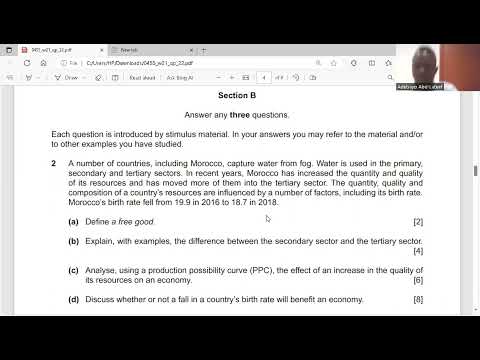 ▶ Whole paper
Video solution of the whole paper · by Adebayo Business 👨💼 Tutor (ABT). Tap the picture to open it on YouTube.
Solutions follow the official Cambridge mark schemes; marks are shown in grey. Videos are from other YouTube channels. Paper codes read component / series / year: M/J = May/June, O/N = October/November. Past-paper questions © UCLES, reproduced for classroom practice.