Q5 · 9700/41/O/N/20 Q1
Worked solution from the Photosynthesis Theory (Paper 4) booklet, Part 1 of 2.

Worked solution
(a)
Draw a label line from A to a cell in the outer layer (the epidermis). [1]
PEP carboxylase is in the mesophyll cells, so draw a label line from B to a mesophyll cell. [1]
(b)(i)
Cell C is the ring of cells around the vascular bundle in the leaf.
Write: bundle sheath (cell). [1]
(b)(ii)
Write any four of these points.
Mesophyll cells surround (form a ring round) the bundle sheath. [1]
So air or oxygen cannot reach the bundle sheath cells. [1]
So oxygen cannot bind to rubisco or RuBP there. [1]
There is a high concentration of carbon dioxide in the bundle sheath cells. [1]
This stops photorespiration, so the rate of photosynthesis stays high at high temperatures. (Any four of these points.)
(c)(i)
Read the C3 high CO2 line and the C4 high CO2 line on Fig. 1.2.
Both rise as temperature increases at low temperatures (up to 25 °C), and both fall at high temperatures (above 35 °C). [1]
C3 has the higher rate at low temperatures (below about 22 °C). C3 is higher, for example 10 against about 7 μmol m−2 s−1 at 5 °C. [1]
C3 has the lower rate at high temperatures (above about 22 °C), for example about 19 against 38 μmol m−2 s−1 at 40 °C. [1]
C3 peaks at 25 °C and C4 peaks at 30–35 °C, so C3 has the lower optimum temperature. C3 also has the lower maximum rate (about 33 against 43 μmol m−2 s−1). [1]
(c)(ii)
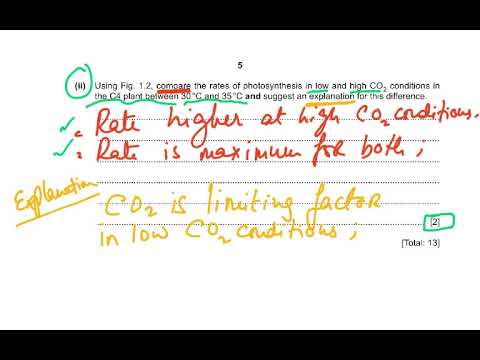
Between 30 °C and 35 °C the C4 plant in high CO2 has a higher rate (about 43) than in low CO2 (about 30 μmol m−2 s−1). [1]
Explanation: carbon dioxide is the limiting factor in low CO2 conditions. [1]
Official mark scheme

 ▶ Whole paper
Video solution of the whole paper · by Dr Saira Biology. Tap the picture to open it on YouTube.
Solutions follow the official Cambridge mark schemes; marks are shown in grey. Videos are from other YouTube channels. Paper codes read component / series / year: M/J = May/June, O/N = October/November. Past-paper questions © UCLES, reproduced for classroom practice.