Q12 · 9701/22/F/M/25 Q3
Worked solution from the Group 17 Theory (Paper 2) booklet, Part 3 of 4.

Worked solution
(a)(i)
Write bromine: (dark/red-)brown liquid and iodine: grey/black solid. [1]
(a)(ii)
Bond energy falls from 242 to 151 kJ mol−1 down the group. The reason is the size of the atoms.
The atoms get larger down the group. [1]
So the bonding electron pair is further from the nucleus (longer bond, less orbital overlap), giving a weaker attraction and a weaker bond. [1]
(b)
Chlorine reacts with water to make chloric(I) acid, which kills bacteria.
Write Cl2 + H2O → HCl + HOCl [1]
The active species ClO− / HOCl kills bacteria. [1]
(c)(i)
H2S forms when the halide is a strong enough reducing agent to reduce S fully. That is the best reducing agent, I−.
Write sodium iodide, NaI. [1]
(c)(ii)
The weakest reducing agent is Cl−, so it only gives HCl.
Write sodium chloride, NaCl. [1]
(c)(iii)
Write: a cream (off-white) precipitate forms. [1]
(d)(i)
IBr is a polar molecule, but it is also a molecule with electrons.
Write instantaneous dipole – induced dipole (London) forces AND permanent dipole – permanent dipole forces. [1]
(d)(ii)
Write electrophilic addition. [1]
(d)(iii)
Propene is CH2=CH–CH3. I and Br add across the double bond, one on each carbon.
Draw CH3–CHI–CH2Br [1] and CH3–CHBr–CH2I [1].
(d)(iv)
The two molecules differ in where the I and Br are placed.
Write positional (regio-) isomerism. [1]
(d)(v)
Think about which carbocation is more stable.
The secondary carbocation (intermediate [CH3CHCH2I]+) is more stable and so is preferred. [1]
IBr is a polar molecule (I and Br have different electronegativities), so the Iδ+ end attacks first. [1]
Official mark scheme

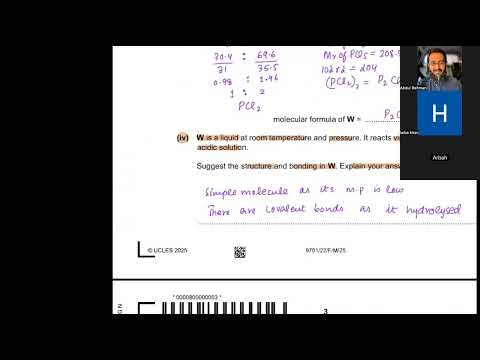 ▶ Whole paper
Video solution of the whole paper · by Chemup. Tap the picture to open it on YouTube.
Solutions follow the official Cambridge mark schemes; marks are shown in grey. Videos are from other YouTube channels. Paper codes read component / series / year: M/J = May/June, O/N = October/November. Past-paper questions © UCLES, reproduced for classroom practice.