Q31 · 9708/23/O/N/20 Q1
Worked solution from the International economic issues Theory (Paper 2) booklet, Part 3 of 5.

Worked solution
(a)
Look at Fig. 1.2: the line starts at about 3.1 RM per US dollar in July 2013 and ends at about 4.2 in July 2017.
Write: the ringgit depreciated against the US dollar. [1]
Justify: it takes more ringgit to buy one US dollar (from about 3.1 to 4.2), so the ringgit is worth fewer dollars. [1]
(b)(i)
Write: a fall (depreciation) in the exchange rate should make exports cheaper and imports dearer, so the balance of trade in goods and services should show a bigger surplus or a smaller deficit. [1]
A rise (appreciation) in the exchange rate should make exports dearer and imports cheaper, so the balance should show a smaller surplus or a bigger deficit. [1]
(b)(ii)
Write: in general the figures do not confirm the relationship because the two lines do not appear to be closely related. [1]
Use the data: from about mid-2015 to early 2016 the ringgit depreciated sharply (from about 3.6 to about 4.4) but the balance of trade fell (from about RM21 000 million to about RM17 000 million), which is the opposite of what is expected. (Accept a period where it is confirmed: from July 2016 to July 2017 the ringgit fell from about 4.0 to 4.2 and the surplus rose from about RM16 000 million to RM22 000 million.) [1]
(c)
Write: the balance of trade in goods and services is only one part of the current account. The current account also includes the primary income and secondary income balances (income and current transfers), which are not in the trade figure. [1]
The current account balance (RM9642 million) is smaller than the trade balance (RM22 045 million), so the sum of these other balances must be negative (RM9642 million − RM22 045 million = −RM12 403 million). [1]
(d)
Give two reasons, each identified and then explained. Any valid reason is accepted; two examples follow.
Reason 1: government subsidies to export industries. [1]
These lower the price of exports, [1]
making Malaysian goods and services more competitive in world markets, so exports rise. [1]
Reason 2: a rise in the rate of direct taxes in Malaysia. [1]
This reduces disposable incomes, [1]
so people can afford fewer imports, and import spending falls, widening the surplus. [1]
(e)
Discuss means: explain the advantages of a surplus, the disadvantages, then decide whether the government should be concerned.
Advantage: a surplus means higher net exports, which increases aggregate demand. [1]
This can lead to higher employment. [1]
It can also raise real GDP (economic growth). [1]
But if the economy is near full capacity, the extra demand can cause demand-pull inflation. [1]
If the surplus is kept up by government intervention (such as subsidies), trading partners may be unhappy and might retaliate. [1]
Conclusion: the government need not be too concerned while the surplus brings growth and jobs, but it should watch for inflation and for tension with trading partners. [1]
Official mark scheme

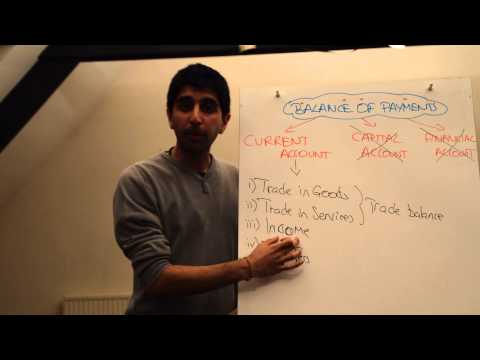 ▶ Topic lesson
A lesson on this topic · by EconplusDal. Tap the picture to open it on YouTube.
Solutions follow the official Cambridge mark schemes; marks are shown in grey. Videos are from other YouTube channels. Paper codes read component / series / year: M/J = May/June, O/N = October/November. Past-paper questions © UCLES, reproduced for classroom practice.