Q65 · 9706/31/O/N/22 Q5
Worked solution from the Cost and management accounting (A Level) Theory (Paper 3) booklet, Part 4 of 4.

Worked solution
(a)
Payback ignores discounting. Write: payback uses cash flows that are not discounted, [1]
so the cash flows can add up to the purchase price in total, but once discounted they may not cover it (the NPV is negative), especially if the cash flows come mostly in the later years. [1]
(b)
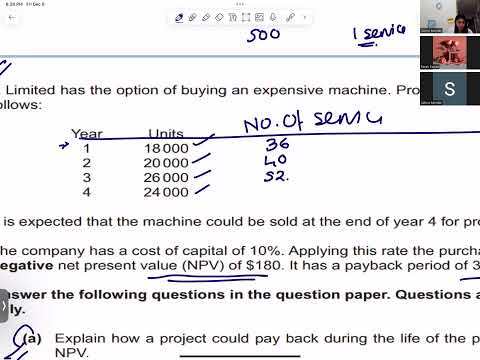
Number of services = units ÷ 500 (existing policy) and units ÷ 2 000 (reduced policy); the decrease is the difference. Cost saving = decrease × $300. Repairs are the extra repair costs (a cost, so in brackets).
| Year | Decrease in number of services | Cost savings $ | Repairs $ | Total change $ |
|---|---|---|---|---|
| 1 | 27 | 8 100 | (2 000) | 6 100 |
| 2 | 30 | 9 000 | (5 600) | 3 400 |
| 3 | 39 | 11 700 | (12 600) | (900) |
| 4 | 36 | 10 800 | (19 900) | (9 100) |
Decrease in services correct for years 1 and 2 [1]
Decrease in services correct for years 3 and 4 [1]
Cost savings column correct (own figure) [1]
Repairs column correct [1]
Total change column correct (own figure) [1]
(c)
Discounted cash flow = total change × discount factor. Add the total to the existing NPV.
| Year | Total change $ | Discount factor | Discounted cash flow $ |
|---|---|---|---|
| 1 | 6 100 | 0.909 | 5 545 |
| 2 | 3 400 | 0.826 | 2 808 [1] |
| 3 | (900) | 0.751 | (676) |
| 4 | (9 100) | 0.683 | (6 215) [1] |
| Increase in NPV | 1 462 [1] | ||
| Existing NPV | (180) [1] | ||
| Revised NPV | 1 282 [1] |
(d)
Write: the revised NPV is now positive ($1 282), [1]
but breakdowns become more likely, causing disruption to production and higher repair costs, [1]
which might mean some orders are not fulfilled on time, [1]
with a loss of reputation among customers. [1]
Decision: purchase the machine, because the NPV is now positive and the company's policy is to reject projects with a negative NPV. (Any justified decision with these comments is credited.) [1]
(Other valid comments: delays in repairs if spare parts are not available; overtime premiums may be needed to catch up once the machine is fixed.)
(e)
For NPV to be zero, the sales proceeds must fall until the revised NPV of $1 282 is wiped out. Proceeds are in year 4, so use the year 4 discount factor.
Fall in proceeds needed = $1 282 [1]
= $1 282 ÷ 0.683 [1]
= $1 877 [1]
Proceeds = $16 000 − $1 877 = $14 123 [1]
(f)
Write: IRR is found by using two different discount rates [1]
to calculate two separate NPV values, [1]
usually one positive and one negative. [1]
An intermediate point is then calculated where the NPV would be zero; that rate is the IRR. [1]
Official mark scheme

 ▶ Whole paper
Video solution of the whole paper · by IGCSE / AS LEVEL / A LEVEL MATHS AND ACCOUNTS. Tap the picture to open it on YouTube.
Solutions follow the official Cambridge mark schemes; marks are shown in grey. Videos are from other YouTube channels. Paper codes read component / series / year: M/J = May/June, O/N = October/November. Past-paper questions © UCLES, reproduced for classroom practice.