Q58 · 9708/42/O/N/23 Q3
Worked solution from the The price system and the microeconomy Theory (Paper 4) booklet, Part 6 of 8.

Worked solution
Essay
Evaluate means: explain how perfect competition produces efficiency, then weigh up whether it is the ideal and decide. Plan: efficiency definitions, assumptions, short-run and long-run diagrams, then evaluation and a conclusion.
Productive efficiency means producing at the lowest possible average cost (the lowest point of the AC curve). Allocative efficiency means producing where price equals marginal cost (P = MC), so resources match what consumers want.
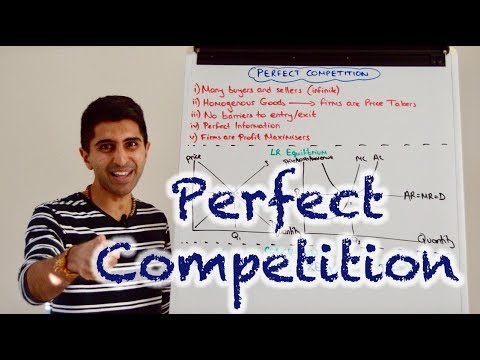
Perfect competition has many buyers and sellers, freedom of entry and exit, identical goods and perfect knowledge. Each firm is a price taker, so its demand curve is horizontal at the market price.
Diagram 1 (short run): draw cost and revenue up the vertical axis and output along the horizontal axis. Draw the firm's U-shaped AC and MC curves (MC cuts AC at its lowest point). Draw a horizontal AR = MR (=D) line above AC, cutting MC at the profit-maximising output. Shade the rectangle between price and AC up to that output as supernormal profit.
Diagram 2 (long run): supernormal profit attracts new entrants, so market supply rises, price falls and the horizontal AR line moves down until it touches the lowest point of AC. Mark the output where AR = AC = MC. Only normal profit is earned, and entry stops.
At this long-run position the firm produces at the lowest point of AC (productive efficiency) and where P = MC (allocative efficiency), so perfect competition reaches both types of efficiency in the long run, but in the short run it may earn supernormal profit or losses.
Evaluation: the model sets a standard of equilibrium where both productive and allocative efficiency occur, which is useful for comparing the outcomes of other market structures (monopolistic competition, oligopoly, monopoly) with the efficiency perfect competition suggests.
But the model is not very realistic: there are few real-world examples of perfect competition, so it may not be the 'ideal' form of market in practice.
Efficiency also includes dynamic efficiency: monopoly profits can pay for research and development (R&D), while perfectly competitive firms earn only normal profit in the long run and have little to spend on R&D.
Conclusion: perfect competition is the most efficient in terms of productive and allocative efficiency, but it is not necessarily the ideal because it is rarely found and may be weaker on dynamic efficiency. It is best seen as a benchmark, so the statement is only partly true.
This reaches the top level for knowledge, understanding and analysis: detailed, accurate analysis, with the diagram(s) fully explained and a clear, well-organised answer to the question. [14]
It reaches the top level for evaluation: a justified conclusion that answers the exact question, with developed, reasoned comments. [6]
Official mark scheme

 ▶ Topic lesson
A lesson on this topic · by EconplusDal. Tap the picture to open it on YouTube.
Solutions follow the official Cambridge mark schemes; marks are shown in grey. Videos are from other YouTube channels. Paper codes read component / series / year: M/J = May/June, O/N = October/November. Past-paper questions © UCLES, reproduced for classroom practice.