Q21 · 9700/43/M/J/22 Q1
Worked solution from the Homeostasis Theory (Paper 4) booklet, Part 1 of 2.

Worked solution
(a)(i)
Name the two parts of the nephron that go down into the medulla.
Loop of Henle [1]
Collecting duct [1]
(a)(ii)
Write: antidiuretic hormone (ADH) (also called vasopressin). [1]
(a)(iii)
Use the values in Table 1.1.
As the RMT increases, the urine concentration increases (positive correlation). [1]
Quote two pairs of figures with units: the beaver has RMT 1.4 and urine concentration 0.90 arbitrary units; the kangaroo rat has RMT 8.6 and urine concentration 10.50 arbitrary units. [1]
Explain the difference (any two of these):
The kangaroo rat lives in the desert, where little water is available, so it must save water. The beaver has plenty of water. [1]
The kangaroo rat has a longer loop of Henle (and collecting duct), so more water is reabsorbed, and its urine is more concentrated (a small volume of urine). The beaver is the opposite. [1]
(b)
The warthog and human have similar kidneys, so the answer must be about other sources of water or ways of saving it. Any two of these:
It gets metabolic water from respiration. [1]
It gets water from the food it eats (for example roots, plants). [1]
Another suitable idea, for example a behavioural response such as being active at night, or no / little sweating, to save water.
(Write any two; only two marks are available.)
Official mark scheme

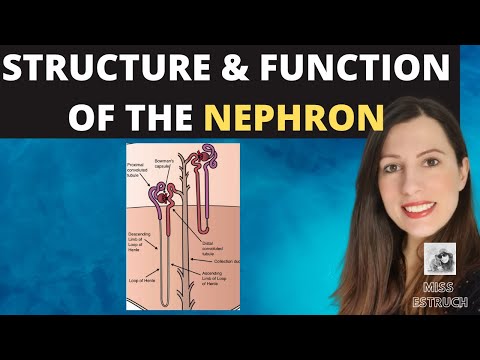 ▶ Topic lesson
A lesson on this topic · by Miss Estruch Biology. Tap the picture to open it on YouTube.
Solutions follow the official Cambridge mark schemes; marks are shown in grey. Videos are from other YouTube channels. Paper codes read component / series / year: M/J = May/June, O/N = October/November. Past-paper questions © UCLES, reproduced for classroom practice.