Q35 · 9706/31/M/J/22 Q2
Worked solution from the Financial accounting (A Level) Theory (Paper 3) booklet, Part 1 of 4.

Worked solution
(a)
Work out each figure first, then place them in the statement.
W1 Property, plant and equipment: balance of the machine not yet recorded = $80 000 − $30 000 = $50 000; depreciation = $50 000 × 15% = $7 500; revaluation reserve = $350 000 − ($300 000 − $96 000) = $146 000
Property, plant and equipment = $606 000 + $50 000 − $7 500 + $146 000 = $794 500
W2 Inventory at the lower of cost and net realisable value: A $57 000 (cost); B $14 000 − $3 000 = $11 000; C $12 000 − $2 500 − $1 000 = $8 500; total $76 500
W3 Retained earnings = $184 000 − depreciation $7 500 − inventory overstated ($80 000 − $76 500) $3 500 − irrecoverable debt $12 000 − provision for legal fee $8 000 = $153 000
W4 Other payables = $24 000 + machine balance $50 000 + provision for legal fee $8 000 = $82 000
Revised statement of financial position at 31 December 2021
| Details | $ |
|---|---|
| Property, plant and equipment (W1) | 794 500 [3] |
| Inventory (W2) | 76 500 [3] |
| Trade receivables ($164 000 − $12 000) | 152 000 [1] |
| Cash and cash equivalents | 86 000 |
| Total current assets | 314 500 |
| Total assets | 1 109 000 |
| Ordinary share capital ($1 shares) | 600 000 |
| Revaluation reserve | 146 000 [1] |
| Retained earnings (W3) | 153 000 [4] |
| Total equity | 899 000 |
| Trade payables | 128 000 |
| Other payables (W4) | 82 000 [2] |
| Total current liabilities | 210 000 |
| Total equity and liabilities | 1 109 000 |
(b)
The relevant standard is IAS 37 Provisions, contingent liabilities and contingent assets. [1]
Claim of $26 000: the lawyer says there is an 80% chance of defending, so a loss is not probable, [1]
so no provision is made, [1]
but the claim must be disclosed as a note to the financial statements (a contingent liability). [1]
Legal cost of $8 000: a provision of $8 000 is made [1]
because it is a liability [1]
of uncertain timing or amount. [1]
(c)
(i) Events after the reporting period are events, favourable and unfavourable, that occur between the end of the reporting period [1]
and the date the financial statements are authorised for issue. [1]
(ii) Adjusting events provide evidence of conditions that existed at the end of the reporting period. [1]
(iii) Non-adjusting events are indicative of conditions that arose after the reporting period. [1]
Official mark scheme

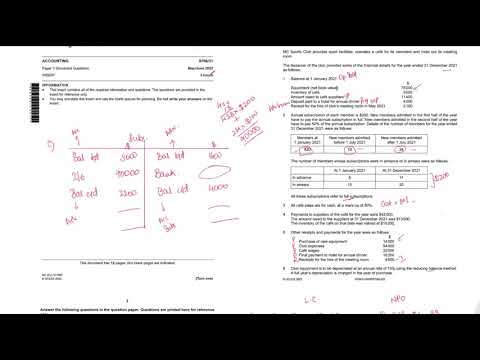 ▶ Whole paper
Video solution of the whole paper · by Edex World. Tap the picture to open it on YouTube.
Solutions follow the official Cambridge mark schemes; marks are shown in grey. Videos are from other YouTube channels. Paper codes read component / series / year: M/J = May/June, O/N = October/November. Past-paper questions © UCLES, reproduced for classroom practice.