Q7 · 9609/32/F/M/23 Q3
Worked solution from the Marketing Theory (Paper 3) booklet, Part 1 of 2.

Worked solution
(a)
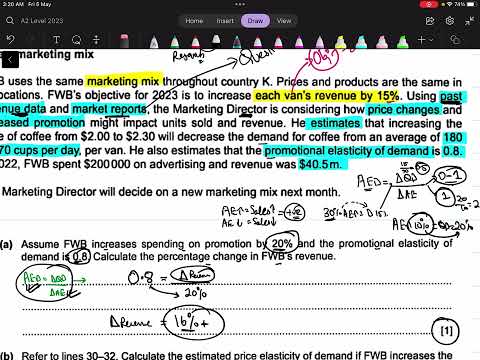
Promotional elasticity of demand = % change in demand ÷ % change in promotional spending, so % change in revenue = elasticity × % change in spending.
= 0.8 × 20 = 16% (increase in revenue). [1]
(b)
Price elasticity of demand (PED) = % change in quantity demanded ÷ % change in price
% change in quantity demanded = −10 ÷ 180 × 100 = −5.56% [1]
% change in price = $0.30 ÷ $2.00 × 100 = 15% [1]
PED = −5.56 ÷ 15 = −0.37 (or −0.4). It is price inelastic. [1]
(c)
Evaluate means: weigh up how useful elasticity is and reach a judgement.
Elasticity shows how far demand responds to a change. Price elasticity compares the change in demand with a change in price. Promotional elasticity compares it with a change in promotion spending. The marketing mix is price, product, promotion and place, planned within a budget to meet the objective.
Use for FWB. FWB's objective for 2023 is to raise each van's revenue by 15%. The estimated PED of −0.37 is inelastic, so a 15% rise in the coffee price would cut demand by only 5.6%. Daily coffee revenue per van would rise from $360 (180 × $2.00) to $391 (170 × $2.30), an increase of 8.6%. This helps the pricing decision and so profit.
The promotional elasticity of 0.8 means that a 20% rise in spending (an extra $40 000) should give a 16% rise in revenue, which is $6.48m on $40.5m. That would beat the 15% target.
Limits. A higher coffee price might cut sales of snacks, which are complements, so total revenue could fall. Customers may buy drinks elsewhere, which would cut FWB's market share. Incomes and unemployment vary across country K, and FWB has a variety of customers, so one elasticity figure may not fit everywhere. Elasticity is an estimate and is hard to measure because other things do not stay equal, especially competitors' reactions.
Judgement. Elasticity is useful because it gives FWB numbers to test its price and promotion plans against the 15% revenue target. But it is only one tool. A good marketing mix also needs other changes, such as to the snacks or to food quality, and the mix should be consistent so that its message attracts customers. How far elasticity helps depends on how strong the competition is and on how accurate the estimates are. So it is useful for guiding the decision, but it should not be the only thing FWB relies on.
This earns the top band for knowledge: developed knowledge of elasticity and of the marketing mix. [2]
It earns the top band for application: it applies the idea to FWB twice or more (the PED of −0.37, $360 to $391, the 0.8 promotional elasticity). [2]
It earns the top band for analysis: it links two or more steps, for example price up → demand falls less than proportionately → revenue and profit rise. [2]
It reaches the top level for evaluation: a developed judgement in context that balances usefulness against the limits of estimates and other factors. [6]
Official mark scheme

 ▶ Whole paper
Video solution of the whole paper · by Bilal Kurd. Tap the picture to open it on YouTube.
Solutions follow the official Cambridge mark schemes; marks are shown in grey. Videos are from other YouTube channels. Paper codes read component / series / year: M/J = May/June, O/N = October/November. Past-paper questions © UCLES, reproduced for classroom practice.