Q102 · 9706/31/M/J/23 Q1
Worked solution from the Financial accounting (A Level) Theory (Paper 3) booklet, Part 3 of 4.

Worked solution
(a)
The partnership profit is the interest on capital plus the residual profit shared by the partners.
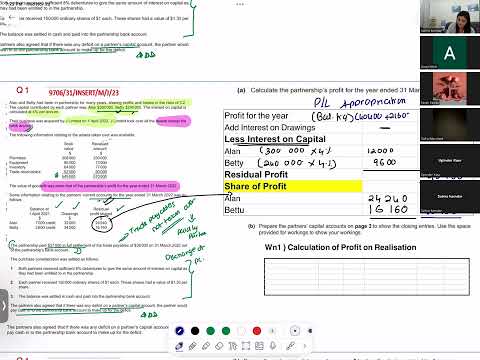
Interest on capital: Alan $300 000 × 4% = $12 000; Betty $240 000 × 4% = $9 600. Total = $21 600. [1]
Residual profit shared: Alan $24 240 + Betty $16 160 = $40 400
Profit for the year = $21 600 + $40 400 = $62 000 [1]
(b)
Workings first.
W1 Current accounts at 31 March 2022 (balance 1 April 2021 + interest on capital + residual profit − drawings)
Alan: $7 000 + $12 000 + $24 240 − $32 000 = $11 240 credit
Betty: $2 600 + $9 600 + $16 160 − $34 000 = ($5 640) debit
W2 Debentures (8% debentures give the same interest as the partners earned on capital): Alan $12 000 ÷ 8% = $150 000; Betty $9 600 ÷ 8% = $120 000
W3 Profit on realisation
| Details | $ |
|---|---|
| Assets taken over ($570 000 − $549 000) | 21 000 |
| Goodwill ($62 000 × 2) | 124 000 |
| Trade payables discount ($39 000 − $37 000) | 2 000 |
| Total | 147 000 |
Shared 3:2: Alan $147 000 × 60% = $88 200; Betty $147 000 × 40% = $58 800
Capital accounts
| Details | Alan $ | Betty $ | Details | Alan $ | Betty $ |
|---|---|---|---|---|---|
| Current account | 5 640 | Balance b/d | 300 000 | 240 000 [1] | |
| J Ltd 8% debentures | 150 000 | 120 000 | Current account | 11 240 | – [2] |
| J Ltd ordinary shares | 195 000 | 195 000 | Profit on realisation | 88 200 | 58 800 [6] |
| Bank | 54 440 | Bank | 21 840 [1] | ||
| Total | 399 440 | 320 640 | Total | 399 440 | 320 640 |
Marks in the table: Betty's current account debit [1]; the debentures row [1] and the ordinary shares row [1] (shares: 150 000 × $1.30 = $195 000 each); Alan's current account credit [1]; profit on realisation, with its three workings figures [5]; the bank entries that balance each account [1] (Alan's $54 440 is paid by the partnership to him, Betty's $21 840 is the deficit she pays in).
The first rows' marks above are already counted in the table: the table's [n] values add up to 10.
(c)
The cash J Limited pays = total purchase consideration − debentures − shares.
Consideration = assets taken over $570 000 + goodwill $124 000 = $694 000 [1]
Less 8% debentures: $150 000 + $120 000 = ($270 000) [1]
Less ordinary shares: 300 000 × $1.30 = ($390 000) [1]
Balance paid in cash = $34 000 [1]
(d)
First find the opening bank balance (W1): capital accounts $540 000 + current accounts at 31 March 2022 ($11 240 − $5 640 = $5 600) = $545 600, less book value of assets taken over $549 000 plus trade payables $39 000.
$545 600 − $549 000 + $39 000 = $35 600 at bank. (Alternative: capital $540 000 + current accounts at 1 April 2021 $9 600 + profit $62 000 − assets $549 000 + payables $39 000 − drawings $66 000 = $35 600.)
Partnership bank account
| Details | $ | Details | $ |
|---|---|---|---|
| Balance b/d (W1) | 35 600 | Trade payables | 37 000 [2] |
| J Limited | 34 000 | Alan | 54 440 [2] |
| Betty | 21 840 | ||
| Total | 91 440 | Total | 91 440 |
Marks: the balance b/d with its working [2]; J Limited's cash [1]; the payments to Alan and Betty's cash in [1] (the table's second row carries the J Limited mark and the Alan/Betty mark).
(e)
Give points for both views, then a decision. Any valid points are accepted.
Should continue (max 2): it is only one year after the purchase, so J Limited should treat the acquisition as a long-term strategy. [1]
Acquiring businesses can bring synergy [1]
Should not continue (max 2): J Limited paid for goodwill in the expectation of extra future profit, and it did not come. [1]
J Limited was too optimistic in its predictions. [1]
Decision: write that J Limited should continue (or should not) and support it with a comment, for example that synergy may not succeed because of a culture clash between the two businesses, so careful planning is needed before the next purchase. [1]
Official mark scheme

 ▶ Whole paper
Video solution of the whole paper · by IGCSE / AS LEVEL / A LEVEL MATHS AND ACCOUNTS. Tap the picture to open it on YouTube.
Solutions follow the official Cambridge mark schemes; marks are shown in grey. Videos are from other YouTube channels. Paper codes read component / series / year: M/J = May/June, O/N = October/November. Past-paper questions © UCLES, reproduced for classroom practice.