Q11 · 9701/42/F/M/23 Q1
Worked solution from the Group 2 Theory (Paper 4) booklet, Part 1 of 1.

Worked solution
(a)(i)
Zinc is [Ar] 3d10 4s2. To form Zn2+, it loses the two 4s electrons.
Write paired arrows (↑↓) in all five 3d boxes, and leave the 4s and 4p boxes empty. [1]
(a)(ii)
The cycle starts at Zn(s) + S(s) and goes up step by step. Write each species on its own line, in this order from the bottom.
Bottom line (just right of ΔHf): Zn(s) + S(s)
After ΔHat(Zn): Zn(g) + S(s)
After ΔHat(S): Zn(g) + S(g)
After IE1: Zn+(g) + S(g) + e–
The lines Zn2+(g) + S(g) + 2e–, Zn2+(g) + S–(g) + e– and Zn2+(g) + S2–(g) are already given. You score for each correct species with its state symbols and for the electron on its line. Any three score 1, any six score 2, all nine score 3. [3]
(a)(iii)
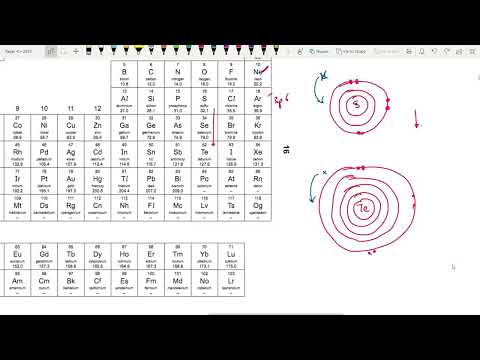
First electron affinity is the energy change when one electron is added to a gaseous atom.
From S to Te the electron affinity becomes less exothermic (less negative).
The atoms get bigger (the outer shell is further from the nucleus, with more shielding), so the nuclear attraction for the incoming electron is weaker. Any two of these three points score 1, all three score 2. [2]
(a)(iv)
Lattice energy depends on ionic charge and ionic size.
The O2– ion has the same charge but is smaller than S2–. [1]
So there is stronger attraction between Zn2+ and O2– (a stronger ionic bond), and the lattice energy is more exothermic. [1]
(b)(i)
Count the moles of gas on each side of step 1: 3 mol O2 on the left, 2 mol SO2 on the right.
ΔS is negative, because there are fewer moles of gas in the products than in the reactants. [1]
(b)(ii)
ΔS = ΣS(products) – ΣS(reactants)
ΔS = (50.8 + 197.7) – (43.7 + 5.7)
ΔS = 248.5 – 49.4 = +199.1 J K–1 mol–1 [1]
(b)(iii)
Use ΔG = ΔH – TΔS, with T in kelvin and ΔS changed to kJ.
ΔG = ΔH – TΔS [1]
T = 800 + 273 = 1073 K, ΔS = 0.218 kJ K–1 mol–1
ΔG = +733 – (1073 × 0.218) = +499 kJ mol–1 (499.086) [1]
(c)(i)
Group 2 nitrates give the oxide, NO2 and O2. Zn(NO3)2 behaves the same way.
Zn(NO3)2 → ZnO + 2NO2 + ½O2 (or 2Zn(NO3)2 → 2ZnO + 4NO2 + O2) [1]
(c)(ii)
Look at the radii in Table 1.2. They increase from Mg2+ to Ba2+.
Thermal stability increases down the group, because the cation radius increases. [1]
A bigger cation polarises (distorts) the nitrate ion less, so the N–O bond is less weakened. [1]
(c)(iii)
Less stable than zinc nitrate means a smaller radius than Zn2+ (74 pm). Only Mg2+ (65 pm) is smaller.
Mg(NO3)2 only. [1]
Official mark scheme

 ▶ Whole paper
Video solution of the whole paper · by CAIE PAPERS SOLVED. Tap the picture to open it on YouTube.
Solutions follow the official Cambridge mark schemes; marks are shown in grey. Videos are from other YouTube channels. Paper codes read component / series / year: M/J = May/June, O/N = October/November. Past-paper questions © UCLES, reproduced for classroom practice.