Q12 · 0455/23/M/J/22 Q3
Worked solution from the International trade and globalisation Theory (Paper 2) booklet, Part 2 of 4.

Worked solution
(a)
Write any two internal economies of scale:
Purchasing (buying) economies [1]
Managerial economies (also credited: technical, financial, risk-bearing, labour, marketing). [1]
(b)
Explain means: name the method, then say what it does. Write two.
Tariffs are taxes on imports, which raise the price of imports. [2]
Import quotas are limits on the quantity of a product that can be imported. [2]
(Also credited: subsidies are grants to domestic producers that lower their prices; embargoes are total bans on a product or country.)
(c)
Draw a demand and supply diagram for the jewellery market.
Draw price (P) up the vertical axis and quantity (Q) along the horizontal axis, both labelled. [1]
Draw a downward-sloping demand curve D and an upward-sloping supply curve S, both labelled, crossing at the first equilibrium (P1, Q1). [1]
Shift demand to the right to a new curve D1, because higher quality makes more people want to buy. [1]
Mark the new equilibrium (P2, Q2) with dotted lines to both axes, and show the first equilibrium with dotted lines too. [1]
Write: higher quality encourages more people to buy jewellery. [1]
So price rises from P1 to P2 and quantity rises from Q1 to Q2. [1]
(d)
Discuss means: why it might benefit, why it might not, then a decision.
Why it might: protection reduces imports, which can reduce a current account deficit. [1]
It helps infant industries to grow, so they become competitive in future. [1]
It helps maintain declining (sunset) industries, which keeps employment. [1]
It protects strategic industries, such as defence. [1]
Why it might not: it raises the price of goods and services, which can cause inflation and lowers consumers' purchasing power. [1]
Other countries may retaliate, making it difficult to export. [1]
It raises costs of production for firms that need imported raw materials. [1]
Domestic firms may become complacent and produce low quality goods. [1]
Conclusion: protection can help some industries and the current account, but it often raises prices and risks retaliation, so the benefit depends on the type of protection and how long it lasts.
Official mark scheme

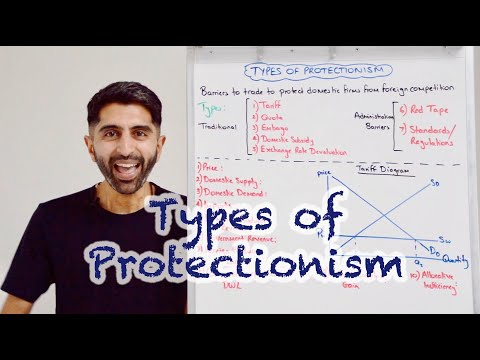 ▶ Topic lesson
A lesson on this topic · by EconplusDal. Tap the picture to open it on YouTube.
Solutions follow the official Cambridge mark schemes; marks are shown in grey. Videos are from other YouTube channels. Paper codes read component / series / year: M/J = May/June, O/N = October/November. Past-paper questions © UCLES, reproduced for classroom practice.