Q40 · 9701/42/F/M/24 Q3
Worked solution from the Chemistry of transition elements Theory (Paper 4) booklet, Part 2 of 4.

Worked solution
(a)(i)
Write: the energies of the 3d and 4s orbitals are similar (the gap is small), so different numbers of electrons can be lost. [1]
(a)(ii)
Fe has 26 electrons: [Ar] 3d6 4s2. Fe3+ loses the 4s electrons first, then one 3d electron.
Write Fe = [Ar] 3d6 4s2 and Fe3+ = [Ar] 3d5. [1]
(b)(i)
Write: a molecule or ion made of a central metal atom or ion surrounded by (bonded to) one or more ligands. [1]
(b)(ii)
Six water molecules are bonded to Fe.
Write: 6 (six). [1]
(b)(iii)
In free water, O has 2 lone pairs and 2 bonding pairs. Lone pairs repel more than bonding pairs.
In the complex one lone pair becomes a bond to Fe, so there is less repulsion and the angle opens up.
Write: the angle is about 106–108° because a lone pair on O is donated to Fe (one more electron pair is now a bonding pair, so repels less). [1]
(b)(iv)
Write: the (degenerate) d orbitals split into two energy levels. [1]
An electron is promoted (moves up) to a higher energy level. [1]
Light energy in the visible region is absorbed, and the colour we see is the complementary colour to the one absorbed. [1]
(b)(v)
The ligands are different (H2O and SCN−).
Write: the d–d energy gap (ΔE) is different in the two complexes. [1]
So a different frequency (wavelength) of light is absorbed (and transmitted), giving a different colour. [1]
(c)(i)
H3PO4 replaces one H2O ligand and the H2O picks up the H+.
Write: [Fe(H2O)6]3+ + H3PO4 → [Fe(H2O)5(H2PO4)]2+ + H3O+ [1]
(c)(ii)
Write: Kstab = [[Fe(H2O)5SCN]2+] ÷ ([[Fe(H2O)6]3+] × [SCN−]) [1]
Units: concentration on top ÷ (concentration × concentration) gives 1 ÷ concentration. Write mol−1 dm3. [1]
(c)(iii)
Kc = Kstab of the SCN complex ÷ Kstab of the H2PO4 complex
Kc = 1.30 × 10² ÷ 59.0
Kc = 2.2 [1]
Official mark scheme

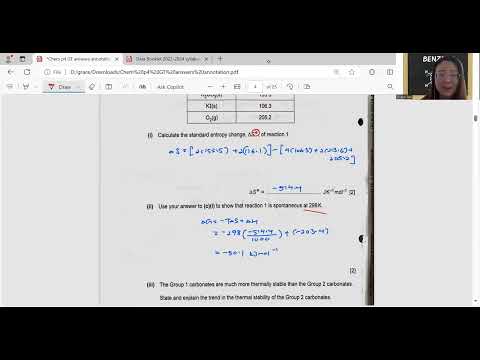 ▶ Starts at Q3 (37:20)
Starts at Q3 (37:20) · by GTChem. Tap the picture to open it on YouTube.
Solutions follow the official Cambridge mark schemes; marks are shown in grey. Videos are from other YouTube channels. Paper codes read component / series / year: M/J = May/June, O/N = October/November. Past-paper questions © UCLES, reproduced for classroom practice.