Q62 · 9708/42/F/M/25 Q2
Worked solution from the The price system and the microeconomy Theory (Paper 4) booklet, Part 6 of 8.

Worked solution
Essay
Evaluate means: explain, weigh up, then judge. Plan: key features of oligopoly, how it avoids price competition, how it keeps supernormal profit, then the limits.
An oligopoly has a few large firms, high barriers to entry, differentiated or similar products and interdependence: each firm's decision depends on how rivals react.
Price rigidity: the kinked demand curve is drawn with price up and quantity along. Demand is elastic above the current price P (rivals do not follow a rise) and inelastic below it (rivals follow a cut), so MR has a gap (vertical break) at Q and costs can change within it without price changing. Firms avoid price competition.
Game theory can predict stable prices through a Nash equilibrium, where no firm gains by changing its price alone.
Supernormal profit can last in the long run because barriers to entry keep new firms out, because collusion lets firms agree prices, or because of limit pricing to deter entrants. Firms can use non-price competition instead.
Evaluation: collusion to set common prices is often illegal and can be hard to maintain.
Barriers to entry may be hard to keep if a government introduces laws to promote more contestable markets.
Extended limit pricing may cut short-run profit, which reduces investment and dynamic efficiency in the long run. Non-price competition such as advertising or product differentiation can be costly and cut profits significantly. Some oligopolies prefer break-even pricing to gain market share rather than maximise profit.
Conclusion: oligopolies can often avoid price competition and keep supernormal profit, but the legal, cost and competition limits mean it is not guaranteed in the long run.
This reaches the top level for knowledge, understanding and analysis: detailed, accurate analysis with relevant concepts, fully explained and well organised. [14]
It reaches the top level for evaluation: a justified conclusion that answers the question, with developed, reasoned comments. [6]
Official mark scheme

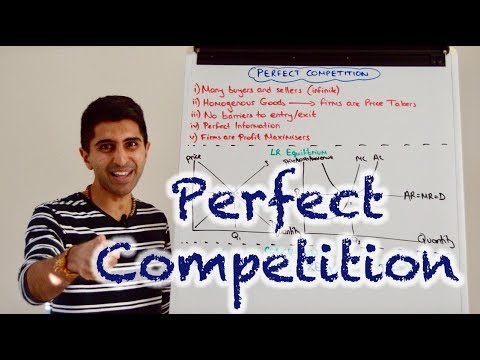 ▶ Topic lesson
A lesson on this topic · by EconplusDal. Tap the picture to open it on YouTube.
Solutions follow the official Cambridge mark schemes; marks are shown in grey. Videos are from other YouTube channels. Paper codes read component / series / year: M/J = May/June, O/N = October/November. Past-paper questions © UCLES, reproduced for classroom practice.