Q34 · 9708/23/O/N/23 Q1
Worked solution from the Government macroeconomic intervention Theory (Paper 2) booklet, Part 3 of 4.

Worked solution
(a)
Negative economic growth means a fall in national output or income (real GDP) over a period. [1]
It is measured by GDP (or real GDP / GNP); on a PPC it is a movement or shift to a point inside the curve. [1]
(b)
Read Fig. 1.1: write that the UK had the most severe recession. [1]
Give the reason: it had the biggest fall in GDP (about −21% in Q2) of the four countries, while the other three countries did consistently better than the OECD average. [1]
(c)
Give two likely reasons for China's strong growth from Q2 2020.
Reason 1: rapidly increasing demand for exports of PPE and other Chinese-made products, which raised net exports (X − M) and so aggregate demand. [1]
Reason 2: China was the first country to experience the pandemic, so it was the first to recover, helped by the government's quick lockdowns that limited the virus. [1]
Now say which gave the greater growth: for example, the surge in export demand, because exports are a direct injection into AD and the extra demand for Chinese output raises GDP quickly. [1]
Support it with a reason: the data shows China's growth rising in every quarter after Q1, which fits export-led demand as other countries were still in recession. [1]
(d)
Explain the effect on employment: recovery raises the components of AD (C + G + I + X − M), so firms produce more and hire more workers, and employment rises. [1]
Say that with higher output and falling unemployment, incomes and spending rise further in a cycle. [1]
Explain price stability: if there is spare capacity (on the flat part of the AS curve), output rises with little effect on prices; but if the economy nears full capacity, rising AD pulls prices up (demand-pull inflation). [1]
Add that firms facing higher costs as demand recovers may pass them on, giving cost-push pressure. [1]
Evaluation: the effects depend on the speed and size of the recovery: a fast, large recovery raises employment but risks inflation sooner. [1]
Conclusion: employment is likely to rise, while price stability is likely to hold if recovery is gradual and spare capacity remains. [1]
(e)
Monetary policy is the use of the interest rate, money supply and exchange rate to influence AD. [1]
Advantage: lower interest rates and a larger money supply (for example relaxing credit rules) make borrowing cheaper, so consumption and investment rise, AD increases and recovery follows. A fall in the exchange rate also makes exports more price competitive. [1]
Disadvantage: expansionary monetary policy may cause inflation, and a lower exchange rate raises the cost of imports. [1]
It also depends on consumer and business confidence and on how much they respond to lower rates, and there are time lags. [1]
Evaluation: the effect depends on how interest-sensitive AD components are, and the result is uncertain; alternative policies such as fiscal policy (which the US and UK also used) could work better or alongside it. [1]
Conclusion: monetary policy is useful but not clearly the best on its own, because its effect is uncertain and it works best together with other policies. [1]
Official mark scheme

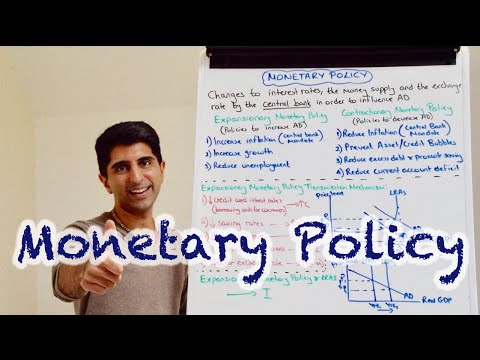 ▶ Topic lesson
A lesson on this topic · by EconplusDal. Tap the picture to open it on YouTube.
Solutions follow the official Cambridge mark schemes; marks are shown in grey. Videos are from other YouTube channels. Paper codes read component / series / year: M/J = May/June, O/N = October/November. Past-paper questions © UCLES, reproduced for classroom practice.