Q62 · 9706/33/O/N/21 Q6
Worked solution from the Cost and management accounting (A Level) Theory (Paper 3) booklet, Part 4 of 4.

Worked solution
(a)
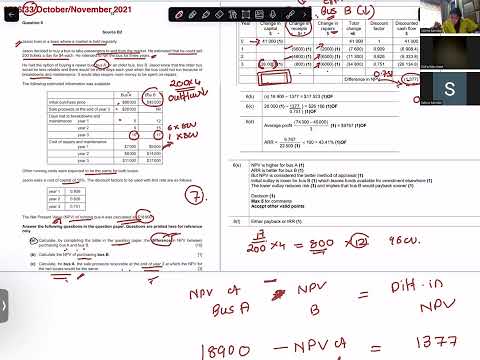
Compare the buses by the change if Jason chooses bus B instead of bus A. Capital: $86 000 − $45 000 = $41 000 saved now. Extra days lost by B: year 1 12 − 5 = 7, year 2 15 − 9 = 6, year 3 17 − 16 = 1; each day loses 200 × $4 = $800, so receipts fall by $5 600, $4 800 and $800. Extra repairs: year 1 $9 000 − $7 000 = $2 000; year 2 $14 500 − $8 000 = $6 500; year 3 $17 000 − $11 000 = $6 000. In year 3 B has no sale proceeds, so $28 000 is lost.
| Year | Capital $ | Receipts $ | Repairs $ | Total change $ |
|---|---|---|---|---|
| 0 | 41 000 | 41 000 [1] | ||
| 1 | (5 600) | (2 000) | (7 600) [2] | |
| 2 | (4 800) | (6 500) | (11 300) [2] | |
| 3 | (28 000) | (800) | (6 000) | (34 800) [3] |
| Year | Total change $ | Discount factor | Discounted cash flow $ |
|---|---|---|---|
| 0 | 41 000 | 1 | 41 000 |
| 1 | (7 600) | 0.909 | (6 908.4) |
| 2 | (11 300) | 0.826 | (9 333.8) |
| 3 | (34 800) | 0.751 | (26 134.8) [1] |
| Difference in NPV | (1 377) [1] |
The difference in NPV is $1 377 (bus B is worse off by this amount). The last two marks follow from your own totals.
(b)
NPV of bus B = $18 900 − $1 377 = $17 523 [1]
(c)
Bus A's NPV must fall by $1 377, so its sale proceeds must fall by $1 377 ÷ 0.751.
Sale proceeds now = $28 000 [1]
Fall = $1 377 ÷ 0.751 [1]
Sale proceeds needed = $28 000 − $1 834 (rounded) = $26 166 [1]
(d)
ARR = average annual profit ÷ average investment × 100
Average profit = ($74 300 − $45 000) ÷ 3 [1]
= $9 767 [1]
Average investment = ($45 000 + nil) ÷ 2 = $22 500 [1]
ARR = $9 767 ÷ $22 500 × 100 = 43.41% [1]
(e)
Advise means: points for each bus, then a decision.
The NPV is higher for bus A. [1]
The ARR is better for bus B (43.41% against 24.56%). [1]
But NPV is considered the better method of appraisal. [1]
Bus B has the lower initial outlay, [1]
which leaves funds available for investment elsewhere. [1]
Decision: buy bus A because of its higher NPV. [1]
(f)
Write payback (or internal rate of return, IRR). [1]
Official mark scheme

 ▶ Whole paper
Video solution of the whole paper · by IGCSE / AS LEVEL / A LEVEL MATHS AND ACCOUNTS. Tap the picture to open it on YouTube.
Solutions follow the official Cambridge mark schemes; marks are shown in grey. Videos are from other YouTube channels. Paper codes read component / series / year: M/J = May/June, O/N = October/November. Past-paper questions © UCLES, reproduced for classroom practice.