Q52 · 9708/22/O/N/25 Q4
Worked solution from the International economic issues Theory (Paper 2) booklet, Part 5 of 5.

Worked solution
(a)
Explain means: name each component and say what it is. Then consider whether a depreciation will always lead to a surplus.
Component 1: trade in goods, the value of physical goods bought and sold abroad, for example computers. [1]
Component 2: trade in services, the value of invisible items such as insurance or tourism. [1]
Component 3: primary income, for example dividends earned from overseas investments. (Secondary income, such as overseas aid or workers' remittances sent home, is also accepted.) [1]
A depreciation in the exchange rate makes exports cheaper and imports dearer in foreign currency terms. [1]
This should raise export revenue and/or reduce import spending, leading towards a surplus. [1]
But other components of the current account, such as services, primary income and secondary income, may also change and decide whether the account ends up in surplus. [1]
Evaluate: whether a surplus appears depends on the price elasticity of demand for exports and imports and on the size of the other components, so it is not always the result. [1]
Conclude: a depreciation may help the current account but will not always lead to a surplus. [1]
(b)
Assess means: weigh the strengths and weaknesses of supply-side policy for reducing a current account deficit, compared with other policies, and decide.
Supply-side policy can be effective in the long run and is less costly to the economy, and it is less likely to cause retaliation by other countries.
Investment in education and training raises worker productivity and enterprise, which lowers costs and makes domestic goods more competitive. Exports rise and imports fall, so the deficit shrinks.
Export subsidies and subsidies to domestic industries that compete with imports, and policies that reduce red tape and encourage competition, also reduce costs. Investment in infrastructure cuts production costs.
However, supply-side policies take time and can be costly, with an opportunity cost, so they are unlikely to cut a deficit in the short term.
Other policies, such as contractionary fiscal and monetary policy (which cut spending on imports), tariffs and currency depreciation, may work more quickly. Each has weaknesses: contractionary policy slows growth and raises unemployment, tariffs may cause retaliation, and depreciation depends on elasticities.
Evaluation: supply-side policy is best for a lasting fix but poor for a quick one.
Conclusion: supply-side policy is likely to be the best long-term way to reduce a current account deficit, because it improves competitiveness without damaging demand or trade relations. However, in the short term it needs to be combined with faster policies.
This reaches the top level for knowledge, understanding and analysis: detailed, accurate analysis, well organised and fully developed, with both sides explained. [8]
It reaches the top level for evaluation: a justified conclusion that answers the question, with developed, reasoned comments on both sides. [4]
Official mark scheme

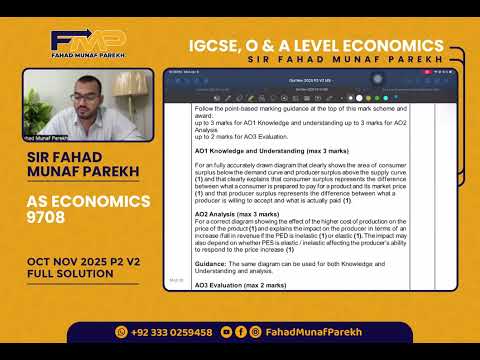 ▶ Whole paper
Video solution of the whole paper · by Fahad Munaf Parekh. Tap the picture to open it on YouTube.
Solutions follow the official Cambridge mark schemes; marks are shown in grey. Videos are from other YouTube channels. Paper codes read component / series / year: M/J = May/June, O/N = October/November. Past-paper questions © UCLES, reproduced for classroom practice.