Q6 · 2210/12/M/J/21 Q1
Worked solution from the Data representation Paper 1 Computer Systems booklet, Part 1 of 3.

Worked solution
(a)
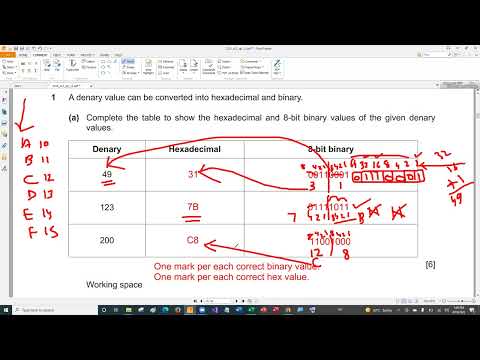
Change each denary value to 8-bit binary, then group the bits in fours for hexadecimal.
| Denary | Hexadecimal | 8-bit binary |
|---|---|---|
| 49 | 31 | 00110001 |
| 123 | 7B | 01111011 |
| 200 | C8 | 11001000 |
49: hexadecimal 31 [1]
49: binary 00110001 [1]
123: hexadecimal 7B [1]
123: binary 01111011 [1]
200: hexadecimal C8 [1]
200: binary 11001000 [1]
(b)
Write any two benefits:
It is easier and quicker to read, write and understand. [1]
It is easier to find errors, and there is less chance of making an error. [1]
It takes up less space on the screen.
Write any two of these.
(c)
Write any three uses:
MAC addresses [1]
URLs [1]
Assembly language [1]
Other accepted answers: error codes or messages, IP addresses, locations in memory, memory dumps.
Write any three.
Official mark scheme

 ▶ Whole paper
Video solution of the whole paper · by Level Up with Aqeel Ahmed: CS Edition. Tap the picture to open it on YouTube.
Solutions follow the official Cambridge mark schemes; marks are shown in grey. Videos are from other YouTube channels. Paper codes read component / series / year: M/J = May/June, O/N = October/November. Past-paper questions © UCLES, reproduced for classroom practice.