Q18 · 9701/22/F/M/25 Q1
Worked solution from the The Periodic Table: chemical periodicity Theory (Paper 2) booklet, Part 2 of 3.

Worked solution
(a)(i)
Cl is more electronegative, so it is −1. P balances this.
PCl3: P +3, Cl −1. [1]
PCl5: P +5, Cl −1. [1]
(a)(ii)
The forward reaction has fewer gas molecules and is exothermic.
High pressure favours the side with fewer gas moles. [1]
Low temperature favours the exothermic direction. [1]
(a)(iii)
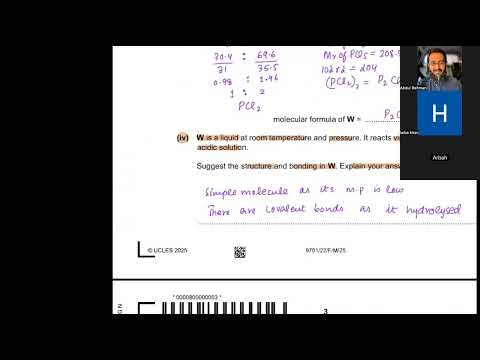
Take 100 g: Cl = 69.6 g, P = 30.4 g.
Moles P = 30.4 ÷ 31.0 = 0.98; moles Cl = 69.6 ÷ 35.5 = 1.96
Ratio P : Cl = 0.98 : 1.96 = 1 : 2. [1]
The Mr is between PCl3 and PCl5, so the molecular formula is P2Cl4. [1]
(a)(iv)
W is simple molecular because it is a liquid with a low melting point (weak intermolecular forces). [1]
The bonding is covalent because it is hydrolysed. [1]
(b)(i)
Chlorine is used up.
Write: the green colour of the gas disappears. [1]
(b)(ii)
Five bonding pairs, no lone pairs.
Write trigonal bipyramidal. [1]
(b)(iii)
P4 + 5O2 → P4O10 [1]
(b)(iv)
Both reactions make phosphoric(V) acid. [1]
(b)(v)
C turns PCl5 into 1,2-dichloroethane, so C is the diol.
Draw HOCH2CH2OH (ethane-1,2-diol). [1]
(c)(i)
Write: it contains a C=C (double or multiple) bond. [1]
(c)(ii)
Write ethanol (as solvent) and heat. [1]
(d)(i)
Chlorine has two isotopes, 35Cl and 37Cl, in a ratio of about 3 : 1.
Write: the peaks are in a 3 : 1 ratio because of the two isotopes of Cl. [1]
(d)(ii)
The peaks at 60 and 62 are the molecular ion with 35Cl and 37Cl.
Write Cl–C≡C–H. [1]
Official mark scheme

 ▶ Whole paper
Video solution of the whole paper · by Chemup. Tap the picture to open it on YouTube.
Solutions follow the official Cambridge mark schemes; marks are shown in grey. Videos are from other YouTube channels. Paper codes read component / series / year: M/J = May/June, O/N = October/November. Past-paper questions © UCLES, reproduced for classroom practice.