Q26 · 0610/42/O/N/20 Q5
Worked solution from the Reproduction Theory (Paper 4) booklet, Part 5 of 6.

Worked solution
(a)
Complete the table. One mark for each of these five entries:
FSH role: stimulates development of the egg (ovum) in the ovary (or secretion of oestrogen). [1]
LH role: stimulates ovulation (or secretion of progesterone). [1]
Oestrogen site of production: ovary (placenta is also accepted). [1]
Progesterone site of production: ovary (or placenta). [1]
Progesterone role: maintains the lining of the uterus. [1]
(b)
Read the graph. Any three of these four points:
Days 0 to 7: the lining decreases in thickness, fastest between days 0 and 3. [1]
Days 7 to 28: the lining increases in thickness. [1]
It stays at the same thickness from about day 21 to 23 until day 28. [1]
(c)
Compare the two diagrams. Any six of these:
Similarities: fertility drugs may be used, to encourage egg development. [1]
Intercourse does not occur, and sperm are collected and washed. [1]
Fertilisation (fusion of egg and sperm) takes place, and the uterus lining must develop for implantation. [1]
Differences: fertilisation is inside the body in AI but in a dish (outside the body) in IVF. [1]
Eggs are removed from the ovary in IVF; in AI ovulation occurs normally. [1]
In IVF the embryo develops outside the body and is put into the uterus, and spare embryos are made and frozen. [1]
Official mark scheme

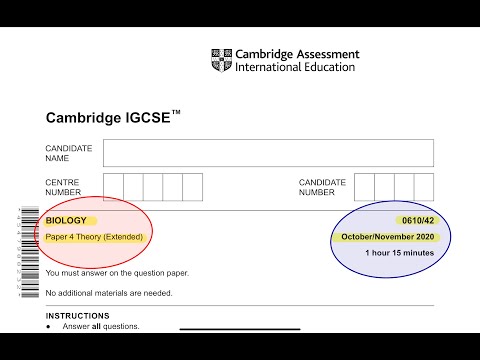 ▶ Starts at Q5 (34:56)
Starts at Q5 (34:56) · by Chemistry & Biology @ Belal Sir. Tap the picture to open it on YouTube.
Solutions follow the official Cambridge mark schemes; marks are shown in grey. Videos are from other YouTube channels. Paper codes read component / series / year: M/J = May/June, O/N = October/November. Past-paper questions © UCLES, reproduced for classroom practice.