Q8 · 7707/23/O/N/24 Q4
Worked solution from the Accounting procedures Theory (Paper 2) booklet, Part 2 of 5.

Worked solution
(a)
Depreciation is charged on the vehicles held at the year end, with a full year on purchases and none on the one sold.
Cost at the year end = $440 000 + $70 000 − $28 000 = $482 000 [1]
Depreciation = $482 000 × 20% = $96 400 [1]
(b)
Delivery vehicles account
Debit side: the two new vehicles bought on credit from L Autos, $70 000. [1]
| Date | Details | $ | Date | Details | $ |
|---|---|---|---|---|---|
| 1 Jan 2023 | Balance b/d | 440 000 | 30 Nov 2023 | Disposal | 28 000 [1] |
| 1 Apr 2023 | L Autos | 70 000 | 31 Dec 2023 | Balance c/d | 482 000 |
| 510 000 | 510 000 | ||||
| 1 Jan 2024 | Balance b/d | 482 000 |
Provision for depreciation of delivery vehicles account
Debit side: the depreciation on the vehicle sold, $16 800, moved out to disposal. [1]
| Date | Details | $ | Date | Details | $ |
|---|---|---|---|---|---|
| 30 Nov 2023 | Disposal | 16 800 | 1 Jan 2023 | Balance b/d | 270 000 |
| 31 Dec 2023 | Balance c/d | 349 600 | 31 Dec 2023 | Income statement | 96 400 [1] |
| 366 400 | 366 400 | ||||
| 1 Jan 2024 | Balance b/d | 349 600 |
Bring down the balances on 1 January 2024 on both accounts ($482 000 and $349 600), using own figures. [1]
Disposal of delivery vehicles account
Debit side: the cost of the vehicle sold, $28 000. [1]
| Date | Details | $ | Date | Details | $ |
|---|---|---|---|---|---|
| 30 Nov 2023 | Delivery vehicles | 28 000 | 30 Nov 2023 | Provision for depreciation | 16 800 [1] |
| 30 Nov 2023 | Bank | 10 500 [1] | |||
| 31 Dec 2023 | Income statement | 700 [1] | |||
| 28 000 | 28 000 |
The $700 is the loss on disposal (net book value $11 200 less $10 500 received), moved to the income statement.
Write the correct dates on the entries. [1]
(c)
Advise: give two advantages, two disadvantages, then a decision.
Advantage: it follows the matching principle (any one valid advantage: vehicles valued more realistically, or more depreciation when the benefit is greatest in the early years). [1]
Advantage: write any one point, for example it follows the matching principle, or vehicles are valued at a more realistic figure. [1]
Advantage: write a second point, for example the annual depreciation charge will be lower, or depreciation may reflect the loss in value more accurately. [1]
Disadvantage: write any one point, for example it is harder to calculate, as it must be worked out again each year. [1]
Disadvantage: write a second point, for example changing method goes against the consistency principle, or makes comparing years more difficult, or the charge is higher in the early years. [1]
(d)
Land is not depreciated: tick No depreciation. [1]
Fixtures & fittings: tick Straight-line. [1]
Loose tools: tick Revaluation. [1]
Official mark scheme

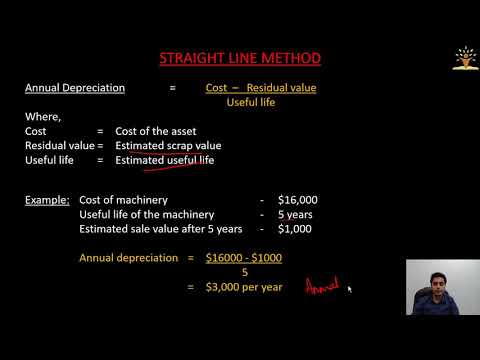 ▶ Topic lesson
A lesson on this topic · by Edex World. Tap the picture to open it on YouTube.
Solutions follow the official Cambridge mark schemes; marks are shown in grey. Videos are from other YouTube channels. Paper codes read component / series / year: M/J = May/June, O/N = October/November. Past-paper questions © UCLES, reproduced for classroom practice.