Q48 · 9700/41/O/N/21 Q9
Worked solution from the Homeostasis Theory (Paper 4) booklet, Part 2 of 2.

Worked solution
(a)
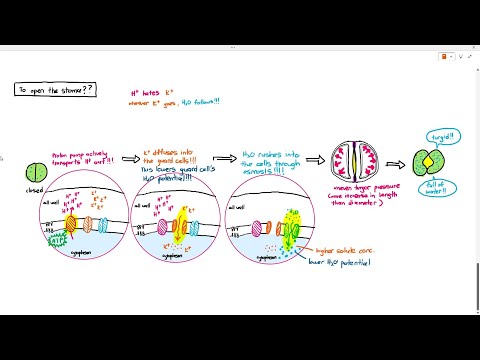
The question asks how guard cells make a stoma open. Describe the events in order and explain why each happens. Any seven of these points score.
Write: a proton pump (H+ carrier protein) in the guard cell's cell surface membrane is active. [1]
H+ ions leave the cell through this pump. [1]
The pump uses energy from ATP. [1]
So the inside of the cell has low H+ concentration and is more negative than the outside. [1]
K+ channel proteins open and K+ ions enter the cell by facilitated diffusion. [1]
Cl− ions also enter the cell. [1]
The water potential of the cell decreases, so water moves in by osmosis. [1]
Extra points that also score: the cell/vacuole volume increases, the cells become turgid, and the thick inner cell wall stretches less than the thin outer wall so the stoma opens. (Only seven marks are available.)
(b)
The question asks why maize and sorghum (C4 plants) still fix CO2 well when it is hot, when many plants lose efficiency to photorespiration. Link each feature to what it does. Any eight of these points score.
These are C4 plants using the C4 pathway. [1]
This decreases photorespiration. [1]
Mesophyll cells form a tightly packed ring [1]
around the bundle sheath cells. [1]
CO2 is first fixed in the mesophyll and the Calvin cycle happens in the bundle sheath cells. [1]
RuBP and rubisco are in the bundle sheath cells, so oxygen/air cannot reach RuBP/rubisco. [1]
In the mesophyll, CO2 combines with PEP (using PEP carboxylase) to form oxaloacetate/malate. [1]
The malate releases CO2 in the bundle sheath cells, so RuBP is carboxylated. [1]
Alternative for the last mark: PEP carboxylase has a high optimum temperature and tolerates high temperatures. (Only eight marks are available.)
Official mark scheme

 ▶ Topic lesson
A lesson on this topic · by OtterBioTutor. Tap the picture to open it on YouTube.
Solutions follow the official Cambridge mark schemes; marks are shown in grey. Videos are from other YouTube channels. Paper codes read component / series / year: M/J = May/June, O/N = October/November. Past-paper questions © UCLES, reproduced for classroom practice.