Q38 · 9708/42/O/N/21 Q7
Worked solution from the The macroeconomy Theory (Paper 4) booklet, Part 4 of 4.

Worked solution
(a)
Explain means: define the quantity theory of money, show how it works, state its assumptions, then consider its use for policy.
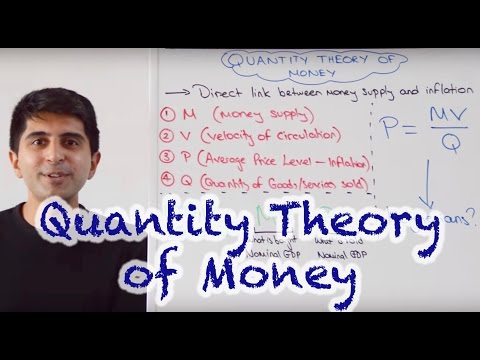
Write the equation PT = MV. Define each term: P is the average price level, T is the number of transactions (or volume of output), M is the money supply, and V is the velocity of circulation of money.
Explain how the terms interact: if V and T are constant, a change in M causes a proportional change in P. So the theory says an increase in the money supply causes inflation. It is a theory of prices.
State the assumptions: V is constant (or stable) and T is fixed because the economy is at full employment, so extra money cannot raise output and only raises prices.
Relevance for macroeconomic policy: a government wanting to reduce the rate of inflation should control the growth of the money supply, for example through monetary policy.
This reaches Level 4: the terms are defined and the theory is clearly explained as a theory of prices and inflation, the assumptions are identified, and its relevance to macroeconomic policy is given. [12]
(b)
Discuss means: explain how fiscal policy could make incomes more equal, why it might not be enough on its own, then decide.
Write: a more equal distribution of income means the gap between the incomes of rich and poor households becomes smaller.
Write: fiscal policy is the use of government spending and taxation to influence the economy.
Policy 1, progressive income tax: higher earners pay a larger share of income, so the income of the rich is reduced and the gap narrows.
Policy 2, government spending on the poor: welfare benefits, and spending on health and education, raise the real incomes of low-income households.
Policy 3, taxes on luxuries and lower taxes on basic goods, so the rich pay more of the tax burden. Discuss the redistributive effects on rich and poor of each change.
Why fiscal policy alone may not be enough: other policies also help, for example monetary and supply-side policies such as education and training that raise the earning power of low-paid workers. High taxes may also reduce incentives to work.
Conclude: fiscal policy can narrow the gap and is the main tool, but it works best with other policies. Give a reason for your judgment.
This reaches Level 4: it explains the meaning of a more equal distribution of income, clearly discusses three policies, and reaches a conclusion. [13]
Official mark scheme

 ▶ Topic lesson
A lesson on this topic · by EconplusDal. Tap the picture to open it on YouTube.
Solutions follow the official Cambridge mark schemes; marks are shown in grey. Videos are from other YouTube channels. Paper codes read component / series / year: M/J = May/June, O/N = October/November. Past-paper questions © UCLES, reproduced for classroom practice.