Q15 · 9709/41/M/J/21 Q7
Worked solution from the Energy, work and power Paper 4 Mechanics booklet, Part 2 of 3.

Worked solution
(a)(i)
The slope is smooth, so the child's potential energy loss turns into kinetic energy.
PE loss = 35 × 10 × 2.5 × sin 30° = 437.5 J [1]
12 × 35 × v2 = 437.5 [1]
v2 = 25, so v = 5 m s−1 [1]
(a)(ii)
On the horizontal section all the kinetic energy is lost to the resistance, which does 250 J per metre.
12 × 35 × 52 = 250d [1]
437.5 = 250d, so d = 1.75 m [1]
(b)
Find the speed at the bottom from the horizontal section, then use that to find the friction force on the slope.
Horizontal section: 12 × 35 × v2 = 250 × 1.05 = 262.5, so v2 = 15 [1]
Normal reaction on the slope: R = 35 × 10 × cos 30° = 303.1 N [1]
On the slope: v2 = 0 + 2a × 2.5 = 15, so a = 3 m s−2 [1]
Newton's second law down the slope: 35 × 10 × sin 30° − F = 35 × 3, so 175 − F = 105 [1]
F = 70 N, and F = μR gives 70 = μ × 303.1 [1]
μ = 0.231 (3 s.f.), which is 2 √315. [1]
Official mark scheme

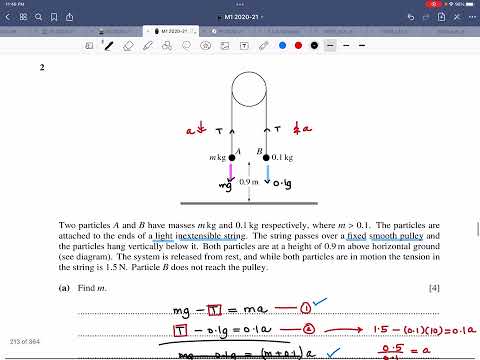 ▶ Whole paper
Video solution of the whole paper · by Mathematics with Shahab Yakoob. Tap the picture to open it on YouTube.
Solutions follow the official Cambridge mark schemes; marks are shown in grey. Videos are from other YouTube channels. Paper codes read component / series / year: M/J = May/June, O/N = October/November. Past-paper questions © UCLES, reproduced for classroom practice.