Q27 · 9700/42/F/M/25 Q4
Worked solution from the Selection and evolution Theory (Paper 4) booklet, Part 2 of 3.

Worked solution
(a)
Both parents do not have the disease but must carry the mutant allele, so they are heterozygous (Hh).
Parental genotypes: Hh × Hh, gametes H, h and H, h. [1]
Punnett square gives offspring genotypes HH, Hh, Hh, hh. [1]
Phenotypes: HH and Hh have no disease; hh has haemochromatosis (the child with the disease). [1]
(b)
Write any two:
Use the known DNA sequence of the HFE gene or the C282Y mutation (from databases or bioinformatics). [1]
Compare the DNA sequence of the fossil HFE gene with the sequence of the normal allele or the C282Y mutation, to find whether the mutation is present in each fossil. [1]
(c)(i)
Explain how the allele was kept. Write any four:
Low iron or meat in the diet (early farmers) acts as a selection pressure. [1]
People with the C282Y (mutant) allele absorb more iron, as heterozygotes. [1]
So they are more likely to survive and reproduce. [1]
So the frequency of the mutant allele increased or was maintained in the population (natural selection, heterozygote advantage: less likely to be iron deficient and not getting haemochromatosis). Any one of these two ideas for the last mark. [1]
(c)(ii)
Compare countries in Fig. 4.1: Ireland has the highest value (10.1%) and the values are lower in countries further away. Write any three:
The percentage is highest in Ireland where the mutation first occurred. [1]
Higher percentages nearer Ireland because of migration (lower further away). [1]
Migration is affected by barriers or borders, and countries differ in type of diet or in the treatments available for the disease. Any one of these. [1]
(d)
Write any valid difference, for example the databases have a different size, or people from a different ethnicity, region or location. [1]
(e)
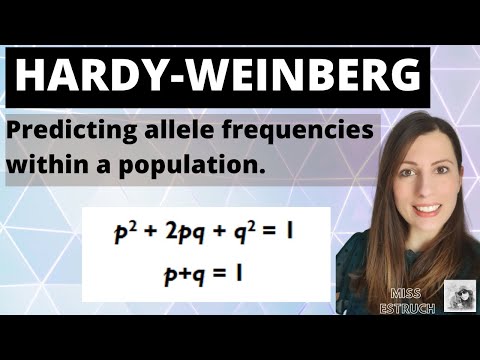
q2 = 9 ÷ 2501 = 0.0036, so q = √0.0036 = 0.06, then p = 1 − 0.06 = 0.94 [1]
2pq = 2 × 0.94 × 0.06 = 0.1128
Number of heterozygotes = 0.1128 × 2501 = 282 people. [1]
Official mark scheme

 ▶ Topic lesson
A lesson on this topic · by Miss Estruch Biology. Tap the picture to open it on YouTube.
Solutions follow the official Cambridge mark schemes; marks are shown in grey. Videos are from other YouTube channels. Paper codes read component / series / year: M/J = May/June, O/N = October/November. Past-paper questions © UCLES, reproduced for classroom practice.