Q26 · 9701/13/M/J/23 Q40
Worked solution from the Analytical techniques MCQ booklet.

Worked solution
The question gives two clues from the mass spectrum: the M : M+1 ratio and the M : M+2 ratio.
M+1 comes from 13C. M : M+1 = 15 : 1, so M+1 is 100 ÷ 15 = 6.7% of M.
Number of carbon atoms = 6.7 ÷ 1.1 = 6 (to the nearest whole number).
M and M+2 are equal in height. This pattern is typical of bromine, because 79Br and 81Br are present in about a 1 : 1 ratio. Chlorine would give M : M+2 of 3 : 1.
So X has 6 carbon atoms and one bromine atom.
Check the options. D 3-bromo-2,2-dimethylbutane has 6 carbons and a Br. ✓
So the answer is D.
A and B contain chlorine, so M : M+2 would be 3 : 1. C contains bromine but has 7 carbons, which would give an M+1 peak of about 7.7%.
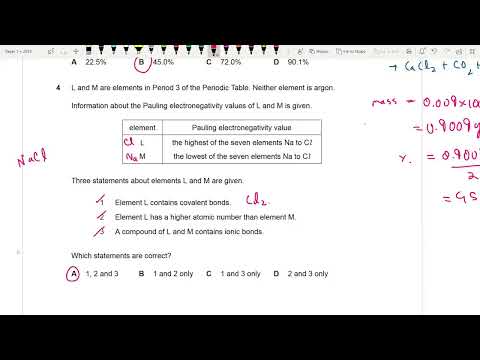 ▶ Whole paper
Video solution of the whole paper · by CAIE PAPERS SOLVED. Tap the picture to open it on YouTube.
Solutions follow the official Cambridge mark schemes. Videos are from other YouTube channels. Paper codes read component / series / year: M/J = May/June, O/N = October/November. Past-paper questions © UCLES, reproduced for classroom practice.