Q2 · 9700/23/O/N/20 Q2
Worked solution from the Transport in plants Theory (Paper 2) booklet, Part 1 of 2.

Worked solution
(a)
Give a function and a matching adaptation for each cell.
Cell B (mesophyll) function: photosynthesis. [1]
Adaptation: chloroplasts (chlorophyll) absorb light. [1]
One more adaptation, for example a large vacuole keeps chloroplasts at the edge, or a moist cell wall lets water evaporate for transpiration, or a thin cell wall helps gas exchange. [1]
Cell C (sieve tube element) function: transport of sucrose and other assimilates. [1]
Adaptation, any two of these: peripheral cytoplasm and no nucleus, so more space and less resistance to flow; elongated cells end to end make tubes; plasmodesmata to the companion cell for loading; sieve pores let sap flow between elements. Write two, but only one more mark is given here, because part (a) is out of 5. [1]
(b)
The infoldings make the cell surface much bigger. Any three:
They increase the surface area of the cell surface membrane. [1]
So there is room for more proton pumps, which pump protons into the cell wall. [1]
There is also room for more cotransporter proteins, which take in sucrose with protons from the mesophyll cell (cotransport). [1]
Official mark scheme

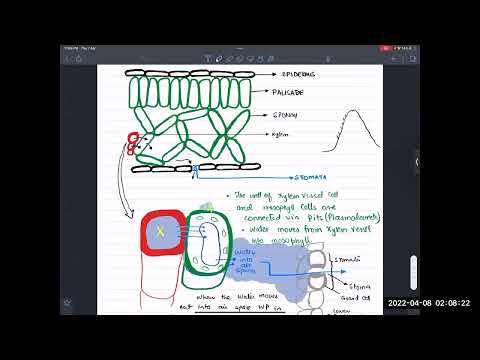 ▶ Whole paper
Video solution of the whole paper · by Dr. Awais Syed. Tap the picture to open it on YouTube.
Solutions follow the official Cambridge mark schemes; marks are shown in grey. Videos are from other YouTube channels. Paper codes read component / series / year: M/J = May/June, O/N = October/November. Past-paper questions © UCLES, reproduced for classroom practice.