Q40 · 9706/21/M/J/20 Q1
Worked solution from the Financial accounting (AS Level) Theory (Paper 2) booklet, Part 4 of 5.

Worked solution
(a)
Write: where there is no agreement, profits and losses are shared equally among the partners. [1]
(b)
Explain two reasons (1 mark to identify, 1 to develop each).
Reason 1: it avoids disputes. [1]
The agreement can set management responsibilities, limits on drawings and the amounts of fixed capital, so each partner knows what was agreed. [1]
Reason 2: it ensures partners are properly rewarded (or penalised) for what they contribute. [1]
It can reward partners who take more management responsibility or provide more capital, and penalise partners whose drawings are largest. [1]
(c)
W1 Administrative expenses. The $1 800 insurance covers 3 months to 29 February 2020; January and February 2020 (2 months) are prepaid.
Prepaid = $1 800 × 2/3 = $1 200 [1]
Administrative expenses = $18 270 − $1 200 = $17 070 [1]
W2 Wages of assistant. One day's pay = $350 ÷ 5 = $70, so three days due = $210.
Wages due = $210 [1]
Wages = $15 540 + $210 = $15 750 [1]
W3 Loss on disposal of equipment. The equipment cost $2 000 on 1 January 2017 and was depreciated in 2017 and 2018 (none in the year of disposal): $2 000 × 15% × 2 = $600.
Carrying amount = $2 000 − $600 = $1 400 [1]
Loss = $1 400 − $480 = $920 [1]
W4 Depreciation of equipment (straight line; the $2 000 item sold in the year gets no depreciation, so it is taken out of the $11 000 cost)
15% × ($11 000 − $2 000) [1]
= $1 350 [1]
Hamza and Noor Income statement for the year ended 31 December 2019
| Details | $ |
|---|---|
| Revenue | 45 400 |
| Administrative expenses (W1) | (17 070) |
| Wages of assistant (W2) | (15 750) |
| Interest on loan from Hamza: 8% × $10 000 × 9/12 | (600) [1] |
| Loss on disposal of equipment (W3) | (920) |
| Depreciation: equipment (W4) | (1 350) |
| Depreciation: motor vehicle 20% × ($20 000 − $7 200) | (2 560) [1] |
| Profit for the year | 7 150 [1] |
(d)
Hamza's drawings are $2 900 over the $14 000 allowed; Noor's $13 200 is under it, so only Hamza is charged interest. The profit of $7 150 plus the interest is less than Noor's salary, so a loss is left to share 3 : 2.
Hamza and Noor Appropriation account for the year ended 31 December 2019
| Details | $ |
|---|---|
| Profit for the year | 7 150 |
| Add interest on drawings: Hamza 10% × $2 900 | 290 [1] |
| 7 440 | |
| Less salary: Noor | (11 000) [1] |
| Residual loss to share | (3 560) |
| Share of loss: Hamza 3/5 × $3 560 | 2 136 [1] |
| Share of loss: Noor 2/5 × $3 560 | 1 424 [1] |
(e)
Start with the opening debit balance as a negative figure, add what Hamza is credited with, and take off what he is debited with.
| Hamza's current account | $ |
|---|---|
| Opening balance (debit) | (1 290) |
| Add loan interest | 600 [1] |
| Less interest on drawings | (290) [1] |
| Less drawings | (16 900) [1] |
| Less share of residual loss | (2 136) [1] |
| Closing balance (debit) | (20 016) [1] |
(f)
Advise means: give the points for each option, then a decision. Write at least one benefit and one drawback for each option.
Option 1 (new partner): a permanent source of finance and no security is required, [1]
but profits will have to be shared with the new partner. [1]
Option 2 (bank loan): profits are still shared by the two partners, [1]
but interest charges will reduce profits. [1]
Advice: write which option the partners should choose (either is accepted), supported by the points above. [1]
Official mark scheme

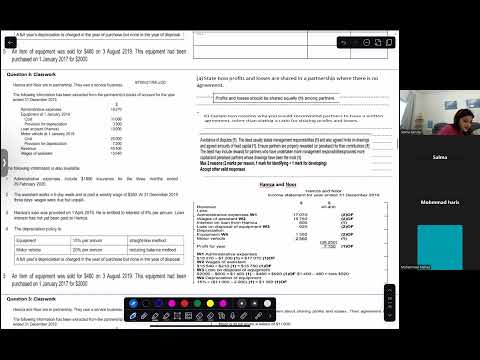 ▶ Whole paper
Video solution of the whole paper · by IGCSE / AS LEVEL / A LEVEL MATHS AND ACCOUNTS. Tap the picture to open it on YouTube.
Solutions follow the official Cambridge mark schemes; marks are shown in grey. Videos are from other YouTube channels. Paper codes read component / series / year: M/J = May/June, O/N = October/November. Past-paper questions © UCLES, reproduced for classroom practice.