Q32 · 9701/42/F/M/22 Q2
Worked solution from the Chemical energetics Theory (Paper 4) booklet, Part 4 of 4.

Worked solution
(a)(i)
Count the states. 3 mol of solid turn into 1 mol of liquid and 2 mol of gas, so there is more disorder. [1]
(a)(ii)
Use ΔG = ΔH − TΔS. ΔS is positive.
As T increases, TΔS becomes more positive (greater than ΔH). [1]
So ΔG becomes more negative and the reaction becomes more feasible. [1]
(b)(i)
ΔS = S(products) − S(reactants)
= (314 + 131) − (19 + 3 × 187) [1]
= 445 − 580 = −135 J K−1 mol−1 [1]
(b)(ii)
Reaction 3 is reversed, so its ΔS = +135 J K−1 mol−1. It becomes feasible when ΔG = 0, so T = ΔH / ΔS. [1]
T = 219 300 / 135 = 1624 K [1]
(c)
moles Si = 1.00 / 28.1 = 0.0356 mol; moles e− = 4 × 0.0356 = 0.142 mol (0.1423 before rounding) [1]
Q = 0.1423 × 96 500 = 13 740 C; t = Q / I = 13 740 / 6.00 = 2289 s (2290 s) [1]
Official mark scheme

 ▶ Whole paper
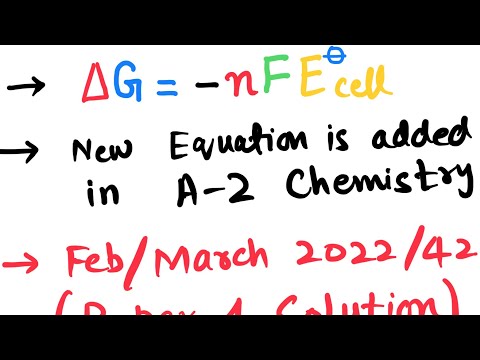
Video solution of the whole paper · by ChemBridge. Tap the picture to open it on YouTube.
Solutions follow the official Cambridge mark schemes; marks are shown in grey. Videos are from other YouTube channels. Paper codes read component / series / year: M/J = May/June, O/N = October/November. Past-paper questions © UCLES, reproduced for classroom practice.