Q31 · 9708/21/M/J/23 Q2
Worked solution from the Basic economic ideas and resource allocation Theory (Paper 2) booklet, Part 5 of 5.

Worked solution
(a)
Explain means: show with a diagram how each cause works, then judge which has the more immediate impact.
Diagram: label the vertical axis "good Y" and the horizontal axis "good X". Draw a PPC that touches both axes and label it PPC1. [1]
A movement along the PPC (point A to point B) shows a trade-off: more of one good means less of the other. [1]
A shift of the PPC (draw PPC2 outside PPC1) shows an increase in production of both goods with no trade-off. [1]
A movement along the PPC is caused by a reallocation of resources, [1]
as resources are moved between the two types of product, which involves an opportunity cost. [1]
A shift of the PPC is caused by an increase in the quantity and/or quality of resources, allowing more of both goods to be produced. [1]
Evaluate: a movement along the curve is likely to have the most immediate impact, because resources can be reallocated quickly, [1]
whereas a shift takes time because quantity or quality of resources must grow first. Conclusion: a movement along the PPC has the more immediate impact, a shift the larger long-run gain. [1]
(b)
Assess means: weigh up both classifications, then reach a judgement.
Education is a merit good: it is a private good that is both rival and excludable.
So it can be provided through a market, because it is possible to charge a price for it, although the state can also provide it.
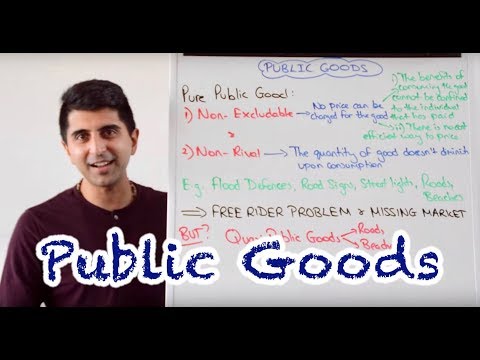
A public good is different: it is non-rival and non-excludable.
So it is difficult, if not impossible, to charge a price because of the free rider problem, and it has to be provided by the state.
Evaluate: public goods can only be provided by the state, but merit goods will be under-provided in the free market, so governments should intervene to increase provision.
However, if demand for education is extremely low in a country when provided through a market, a government could decide to provide it entirely through the state.
Conclusion: education should be classified as a merit good rather than a public good, because it is rival and excludable.
This reaches the top level for knowledge, understanding and analysis: detailed, accurate explanation of both types of good, developed and well organised. [8]
It reaches the top level for evaluation: a justified conclusion that answers the question, with developed, reasoned comments. [4]
Official mark scheme

 ▶ Topic lesson
A lesson on this topic · by EconplusDal. Tap the picture to open it on YouTube.
Solutions follow the official Cambridge mark schemes; marks are shown in grey. Videos are from other YouTube channels. Paper codes read component / series / year: M/J = May/June, O/N = October/November. Past-paper questions © UCLES, reproduced for classroom practice.