Q3 · 2281/23/O/N/20 Q4
Worked solution from the International trade and globalisation Theory (Paper 2) booklet, Part 2 of 4.

Worked solution
(a)
Write: deregulation is the removal of rules (regulations). [2]
(Or: less government intervention [1] to encourage competition [1].)
(b)
Write any two benefits (one mark to identify, one to explain, for each).
Consumer sovereignty: [1] consumers decide what will be produced. [1]
Or: choice: [1] a number of firms may produce a product. [1]
Or: low prices: [1] competition means firms must charge low prices to keep customers. [1]
Or: high quality: [1] the profit incentive encourages firms to raise quality to attract consumers. [1]
(Any two benefits with explanations earn the 4 marks.)
(c)
Analyse means: give each step of the chain of reasoning and link them.
Education raises skills and qualifications, [1]
which raises the productivity of workers, [1]
and increases the quality and quantity of output. [1]
Subsidies lower firms' costs of production, [1]
which encourages firms to increase production and so raises supply, [1]
lowering the price, so a higher output is bought and sold, which means economic growth. [1]
(Also credited: education may attract multinational companies (MNCs) and reduce unemployment.)
(d)
Discuss means: explain why it might, explain why it might not, then decide.
Why it might reduce the surplus: lower tariffs reduce the price of imports, [1]
removing quotas (or a ban) lets more imports be bought, [1]
so import expenditure rises, [1]
which may reduce the gap between export revenue and import expenditure. [1]
Why it might not: demand for imports may be price inelastic, [1]
other countries may also reduce their trade restrictions, so export revenue rises to match the higher import spending, [1]
or the country may have a large surplus on invisibles, or foreign firms may lack the capacity to supply more. [1]
Conclusion: the surplus may rise or fall, depending on how much import prices fall and how much demand for exports rises. [1]
Official mark scheme

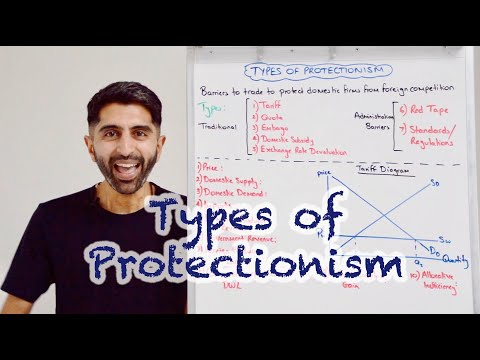 ▶ Topic lesson
A lesson on this topic · by EconplusDal. Tap the picture to open it on YouTube.
Solutions follow the official Cambridge mark schemes; marks are shown in grey. Videos are from other YouTube channels. Paper codes read component / series / year: M/J = May/June, O/N = October/November. Past-paper questions © UCLES, reproduced for classroom practice.