Q74 · 9701/13/M/J/25 Q6
Worked solution from the Chemical energetics MCQ booklet.

Worked solution
We want ΔH for 4NH3 + 5O2 → 4NO + 6H2O, using enthalpies of formation. O2 is an element, so its ΔHf = 0.
ΔH = Σ ΔHf(products) − Σ ΔHf(reactants)
Products: 4(+90.3) + 6(−241.8) = +361.2 − 1450.8 = −1089.6 kJ
Reactants: 4(−46.1) = −184.4 kJ
ΔH = −1089.6 − (−184.4) = −905.2 kJ mol−1
So the answer is C.
A has the wrong sign. B (−105.4) does not multiply by the coefficients 4 and 6. D (−1274.0) adds the reactants instead of subtracting them: −1089.6 − 184.4 = −1274.0.
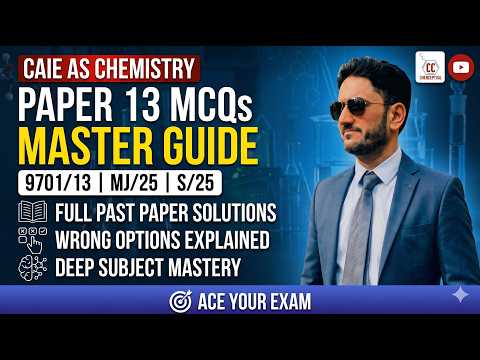 ▶ Starts at Q6 (10:21)
Starts at Q6 (10:21) · by Chemceptual. Tap the picture to open it on YouTube.
Solutions follow the official Cambridge mark schemes. Videos are from other YouTube channels. Paper codes read component / series / year: M/J = May/June, O/N = October/November. Past-paper questions © UCLES, reproduced for classroom practice.