Q8 · 9701/42/O/N/25 Q8
Worked solution from the Polymerisation Theory (Paper 4) booklet, Part 1 of 1.

Worked solution
(a)
Write: the pH at which an amino acid exists as a zwitterion (no overall charge). [1]
(b)
pH 2 is lower than both isoelectric points, so each amino acid is protonated and has a positive charge. The NH2 becomes NH3+ and COOH stays as COOH.
Asparagine at pH 2: [HOOCCH(NH3+)CH2CONH2]+. [1]
Aspartic acid at pH 2: [HOOCCH(NH3+)CH2COOH]+. [1]
(c)
LiAlH4 reduces COOH to CH2OH and an amide to an amine (CH2NH2).
Asparagine gives HOCH2CH(NH2)CH2CH2NH2. [1]
Aspartic acid gives HOCH2CH(NH2)CH2CH2OH. [1]
(d)(i)
Each COOH is changed to COCl, so two SOCl2 are used.
Write: HOOCCH2COOH + 2SOCl2 → ClOCCH2COCl + 2SO2 + 2HCl. [1]
(d)(ii)
Propanedioyl chloride has two COCl groups. Each reacts with the NH2 of one asparagine to form an amide. So G has one CH2 unit joined to two asparagine molecules.
The four amide groups are: two new ones, and two CONH2 groups, one in each asparagine.
Write HOOCCH(CH2CONH2)NHCOCH2CONHCH(CH2CONH2)COOH. Three molecules are joined, with four correct amide groups only. [1]
The whole structure is correct (displayed or skeletal). [1]
(e)
Hot NaOH hydrolyses the amide to a carboxylate ion. The COOH also becomes a carboxylate ion.
Hydrolysis of the amide to the carboxylate ion. [1]
The COOH becomes carboxylate and the rest of the molecule is unchanged: −OOCCH(NH2)CH2COO−. [1]
(f)
The polymer joins the NH2 of one asparagine to the COOH of the next (not the amide on the side chain). The side chain CH2CONH2 stays.
Draw –COCH(CH2CONH2)NH–COCH(CH2CONH2)NH–COCH(CH2CONH2)NH– with a repeat unit in square brackets.
Any two of these four points earn one mark, any three earn two and all four earn three: three monomer residues, all links correct, correct trailing bonds, repeat unit labelled with the correct atoms. [3]
(g)(i)
Optical isomers affect plane polarised light in a similar way, except for direction.
Similarities: both rotate the plane of polarised light, and by the same angle. Difference: they rotate it in opposite directions.
Any two points earn one mark and all three earn two. [2]
(g)(ii)
Write racemic mixture. [1]
Official mark scheme

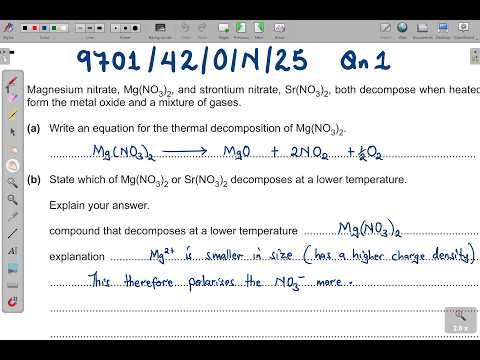 ▶ Whole paper
Video solution of the whole paper · by THE A* CHEMISTRY SOLDIER. Tap the picture to open it on YouTube.
Solutions follow the official Cambridge mark schemes; marks are shown in grey. Videos are from other YouTube channels. Paper codes read component / series / year: M/J = May/June, O/N = October/November. Past-paper questions © UCLES, reproduced for classroom practice.