Q69 · 9706/42/F/M/24 Q1
Worked solution from the Cost and management accounting (A Level) Theory (Paper 4) booklet, Part 4 of 4.

Worked solution
(a)
Write: traditional techniques are based on monetary analysis (cash flows and money values), [1]
and non-financial factors cannot be expressed in money terms, so they are left out. [1]
(b)
Write any two reasonable factors (one mark each), for example:
Effect on staff morale. [1]
Effect on customer satisfaction. [1]
Other accepted answers: effect on the environment, competitive advantage, effect of job losses on social welfare.
(c)
Net cash flow = sales − variable costs − fixed costs (fixed costs of $19 000 exclude amortisation, which is not a cash flow).
| Year | Sales $ | Variable costs $ | Fixed costs $ | Net cash flow $ |
|---|---|---|---|---|
| 1 (6 000 × $19; 6 000 × $11) | 114 000 | (66 000) | (19 000) | 29 000 [1] |
| 2 (10 000 × $22; 10 000 × $11) | 220 000 | (110 000) | (19 000) | 91 000 [1] |
| 3 (8 000 × $18; 8 000 × $13) | 144 000 | (104 000) | (19 000) | 21 000 [1] |
| 4 (4 000 × $15; 4 000 × $14) | 60 000 | (56 000) | (19 000) | (15 000) [1] |
(d)
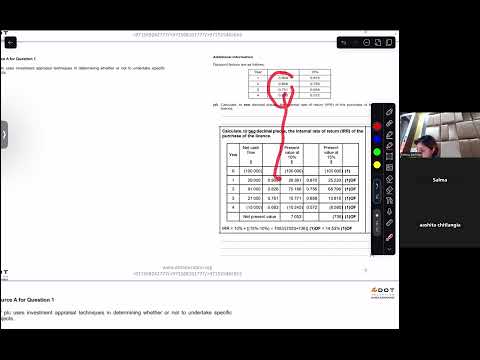
Calculate the NPV at 10% and at 15%, then use: IRR = lower rate + [(higher rate − lower rate) × NPV at lower rate ÷ (NPV at lower rate − NPV at higher rate)].
| Year | Net cash flow $ | DF 10% | PV 10% $ | DF 15% | PV 15% $ |
|---|---|---|---|---|---|
| 0 | (100 000) | 1 | (100 000) | 1 | (100 000) [1] |
| 1 | 29 000 | 0.909 | 26 361 | 0.870 | 25 230 [1] |
| 2 | 91 000 | 0.826 | 75 166 | 0.756 | 68 796 [1] |
| 3 | 21 000 | 0.751 | 15 771 | 0.658 | 13 818 [1] |
| 4 | (15 000) | 0.683 | (10 245) | 0.572 | (8 580) [1] |
| NPV | 7 053 | (736) [1] |
IRR = 10% + [(15% − 10%) × 7 053 ÷ (7 053 + 736)] [1]
= 10% + (5% × 7 053 ÷ 7 789) = 14.53% [1]
(e)
Write: even though the net cash flow in year 4 is negative (the results for year 4 show a loss), [1]
production still gives a positive contribution (selling price $15 is more than the variable cost of $14), [1]
so production should continue to the end of year 4. [1]
(f)
Advise means: give the points and then a decision with a comment.
General comments (any three):
Using extra techniques is more time consuming, [1]
and the results still depend on the accuracy of the estimates. [1]
But they may highlight other aspects, especially the level of risk. [1]
Payback (one point): it is simple to calculate and understand and favours early cash, which is less risky, but it ignores the time value of money and the cash flows after the payback period. [1]
Accounting rate of return (one point): it looks at earnings over the whole life of the project like IRR and NPV, but it uses profits, which are more subjective and affected by accounting policies. [1]
Decision: yes, other techniques should also be used, because they may show the risk that IRR alone does not, even though they take more time. [1]
Official mark scheme

 ▶ Whole paper
Video solution of the whole paper · by IGCSE / AS LEVEL / A LEVEL MATHS AND ACCOUNTS. Tap the picture to open it on YouTube.
Solutions follow the official Cambridge mark schemes; marks are shown in grey. Videos are from other YouTube channels. Paper codes read component / series / year: M/J = May/June, O/N = October/November. Past-paper questions © UCLES, reproduced for classroom practice.