Q85 · 9706/21/O/N/23 Q1
Worked solution from the Financial accounting (AS Level) Theory (Paper 2) booklet, Part 4 of 5.

Worked solution
(a)
The inventory was counted on 4 October, so move it back to 30 September: add the cost of goods sold in those days and take off the goods bought.
Cost of the 4 days' sales = $3 400 × 100 ÷ 125 = $2 720 (sales have a 25% mark-up), so 14 400 + 2 720 [1]
Less purchases in those days, $1 850 [1]
Closing inventory = $14 400 + $2 720 − $1 850 = $15 270 [1]
(b)
Workings
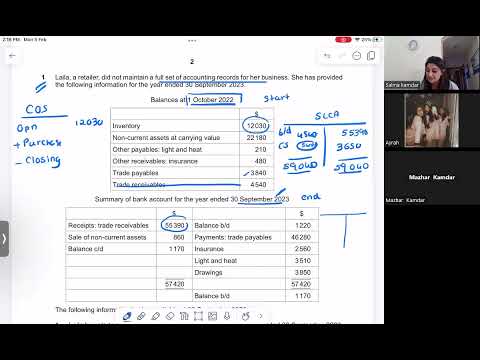
W1 Revenue (credit sales) = cash from trade receivables + closing receivables − opening receivables
= $55 390 − $4 540 [1]
+ $3 650 [1]
= $54 500
Gross profit = 25/125 × $54 500 = $10 900; cost of sales = $54 500 − $10 900 = $43 600
Purchases = cost of sales + closing inventory − opening inventory = $43 600 + $15 270 − $12 030 = $46 840
Depreciation: carrying value sold = $860 proceeds + $120 loss = $980; so $22 180 − $980 = $21 200; 10% × $21 200 = $2 120
Laila: statement of profit or loss for the year ended 30 September 2023
| Details | $ | $ |
|---|---|---|
| Revenue (W1) | 54 500 | |
| Opening inventory | 12 030 | |
| Purchases | 46 840 | [1] |
| Closing inventory | (15 270) | [1] |
| Cost of sales | (43 600) [1] | |
| Gross profit | 10 900 [1] | |
| Insurance | 2 720 | |
| Light and heat | 3 880 | |
| Loss on disposal | 120 | |
| Depreciation | 2 120 | |
| Total expenses | (8 840) [1] | |
| Profit for the year | 2 060 [1] |
(c)
Workings
Equity at 1 October 2022 = assets − liabilities = ($12 030 + $22 180 + $480 + $4 540) − ($3 840 + $210 + bank overdraft $1 220) = $39 230 − $5 270 = $33 960
Other receivables (insurance) = $480 + $2 560 − $2 720 = $320
Trade payables = $3 840 + $46 840 − $46 280 = $4 400
Other payables (light and heat) = $210 + $3 880 − $3 510 = $580
Non-current assets = $21 200 − $2 120 = $19 080
Laila: statement of financial position at 30 September 2023
| Details | $ | $ |
|---|---|---|
| Non-current assets | 19 080 [1] | |
| Inventory | 15 270 | [1] |
| Trade receivables | 3 650 | [1] |
| Other receivables | 320 | [1] |
| Current assets | 19 240 | |
| Total assets | 38 320 [1] | |
| Equity: opening balance | 33 960 | [1] |
| Profit for the year | 2 060 | [1] |
| Drawings | (3 850) | [1] |
| Total equity | 32 170 | |
| Bank overdraft | 1 170 | [1] |
| Trade payables | 4 400 | [1] |
| Other payables | 580 | [1] |
| Current liabilities | 6 150 | |
| Total equity and liabilities | 38 320 [1] |
(d)
Write any four provisions (no partnership agreement):
Profits and losses are shared equally. [1]
No interest is charged on drawings. [1]
No interest is allowed on capital. [1]
Interest of 5% is allowed on partners' loans. [1]
(e)
Write any three disadvantages:
The owner may lack the experience or skills to keep a full set of records. [1]
The owner may have to employ someone to keep the records. [1]
Costs increase, which decreases profits. [1]
Official mark scheme

 ▶ Whole paper
Video solution of the whole paper · by IGCSE / AS LEVEL / A LEVEL MATHS AND ACCOUNTS. Tap the picture to open it on YouTube.
Solutions follow the official Cambridge mark schemes; marks are shown in grey. Videos are from other YouTube channels. Paper codes read component / series / year: M/J = May/June, O/N = October/November. Past-paper questions © UCLES, reproduced for classroom practice.