Q10 · 0610/43/O/N/21 Q1
Worked solution from the Biotechnology and genetic modification Theory (Paper 4) booklet, Part 2 of 2.

Worked solution
(a)
An enzyme is a protein (biological molecule). [1]
It is a catalyst: it speeds up a reaction and is not changed by it. [1]
(b)(i)
Bases pair A with T and G with C. The upper strand is G A A T T C.
Write the lower strand: C T T A A G. [1]
(b)(ii)
The enzyme that cuts DNA at a particular sequence is a restriction enzyme. [1]
(b)(iii)
Look at step 3: the DNA is cut and the pieces have overhanging ends. Any two of these:
It cuts the DNA (molecule). [1]
It forms sticky ends. [1]
The sticky ends are complementary.
(b)(iv)
Any two of these:
The enzyme's active site has a shape that fits the DNA base sequence. [1]
The base sequence (substrate) and the active site are complementary, so only this sequence fits. [1]
(c)(i)
Plasmids are naturally found in bacteria. [1]
(c)(ii)
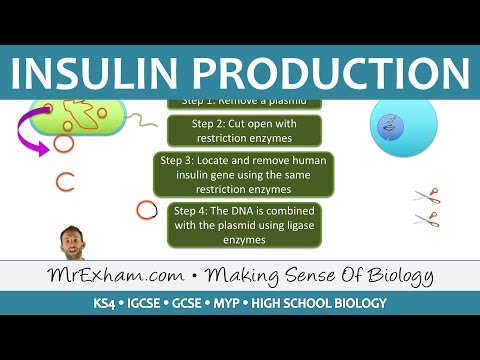
Enzyme 2 joins the gene to the plasmid. Write: ligase (DNA ligase). [1]
(c)(iii)
Step 8 shows the gene joined into the plasmid. Write: recombinant DNA (plasmid). [1]
(d)
Label the x-axis temperature and the y-axis enzyme activity (rate of reaction). [1]
Draw a curve that rises to one peak (the optimum temperature). [1]
Draw the fall on the right of the peak steeper than the rise on the left, because the enzyme is denatured at high temperature. [1]
Official mark scheme

 ▶ Topic lesson
A lesson on this topic · by Mr Exham Biology. Tap the picture to open it on YouTube.
Solutions follow the official Cambridge mark schemes; marks are shown in grey. Videos are from other YouTube channels. Paper codes read component / series / year: M/J = May/June, O/N = October/November. Past-paper questions © UCLES, reproduced for classroom practice.