Q18 · 9700/41/M/J/22 Q3
Worked solution from the Energy and respiration Theory (Paper 4) booklet, Part 2 of 2.

Worked solution
(a)
Building big molecules from small ones is a synthesis reaction.
Write: anabolic (also accepted: condensation, polymerisation). [1]
(b)
Glycolysis begins by adding phosphate groups to glucose.
Write: ATP is used to phosphorylate glucose / add phosphate to glucose. [1]
Then give one reason: this activates glucose / makes it less stable, or it stops glucose leaving the cell, or it is needed to make fructose bisphosphate. [1]
(c)
Substrate-linked phosphorylation makes ATP directly, without the electron transport chain.
Write: in the cytoplasm and the mitochondrial matrix. [1]
(d)
In the link reaction pyruvate is changed to acetyl coenzyme A. Give any two changes.
Write: pyruvate is decarboxylated (loses carbon dioxide). [1]
Write: pyruvate is dehydrogenated / oxidised (loses hydrogen, which is picked up by NAD). [1]
Or: the 2C acetyl group joins coenzyme A to make acetyl CoA. (Any two of the three.)
(e)
Compare the two processes. Any three differences:
Write: oxidative phosphorylation in mitochondria, but photophosphorylation in chloroplasts. [1]
Write: it happens across the inner mitochondrial membrane (cristae), but across the thylakoid membrane. [1]
Write: electrons and H+ come from reduced NAD / reduced FAD in mitochondria, but from photolysis of water / photosystem in chloroplasts. [1]
Also accepted: H+ go into the intermembrane space (mitochondria) but into the thylakoid space (chloroplasts); the final acceptor is oxygen, forming water, in mitochondria but NADP, forming reduced NADP, in chloroplasts. (Any three differences.)
Official mark scheme

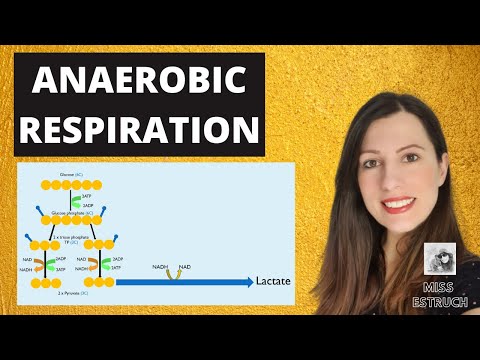 ▶ Topic lesson
A lesson on this topic · by Miss Estruch Biology. Tap the picture to open it on YouTube.
Solutions follow the official Cambridge mark schemes; marks are shown in grey. Videos are from other YouTube channels. Paper codes read component / series / year: M/J = May/June, O/N = October/November. Past-paper questions © UCLES, reproduced for classroom practice.