Q31 · 9701/42/O/N/25 Q5
Worked solution from the Chemistry of transition elements Theory (Paper 4) booklet, Part 1 of 4.

Worked solution
(a)(i)
Co is [Ar]3d74s2. It loses the 4s electrons first.
Write Co2+ = [Ar] 3d7 and Co3+ = [Ar] 3d6. [1]
(a)(ii)
Write: they have vacant d orbitals that are energetically accessible to accept lone pairs. [1]
(a)(iii)
Write: the colour changes from pink to blue. [1]
The cobalt-containing product is aqueous (a solution). [1]
(a)(iv)
Write: [Co(H2O)6]2+ + 4Cl– → [CoCl4]2– + 6H2O (or with 4HCl and 4H+). [1]
(a)(v)
Write: ligand exchange. [1]
(a)(vi)
Write: [Co(H2O)6]2+ + 2OH– → Co(OH)2(H2O)4 + 2H2O (or Co(OH)2 + 6H2O). [1]
(b)(i)
Nernst equation: E = E⦵ + (0.059/z) × log([oxidised]/[reduced]). [1]
E = –0.28 + (0.059/2) × log(0.020) = –0.28 + 0.0295 × (–1.70) = –0.28 – 0.050 = –0.33 V [1]
(b)(ii)
Ecell = 1.33 – (–0.33) = 1.66 V [1]
(b)(iii)
Multiply the cobalt half-equation by 3 so electrons balance.
Write: 3Co + Cr2O72– + 14H+ → 3Co2+ + 2Cr3+ + 7H2O [1]
(b)(iv)
Cobalt is oxidised, so it is the negative electrode.
Write: The Co2+/Co electrode is negative. Electrons flow from the Co2+/Co electrode to the Cr2O72–/Cr3+ electrode. [1]
(c)
Moles Co = 0.547 / 58.9 = 0.00929 mol [1]
Charge = 0.00929 × 2 × 96500 = 1792 C [1]
Time = 1792 / 0.500 = 3584.8 s = 3584.8/60 = 59.7 min [1]
Official mark scheme

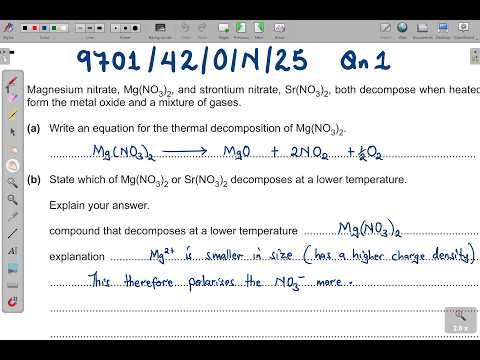 ▶ Whole paper
Video solution of the whole paper · by THE A* CHEMISTRY SOLDIER. Tap the picture to open it on YouTube.
Solutions follow the official Cambridge mark schemes; marks are shown in grey. Videos are from other YouTube channels. Paper codes read component / series / year: M/J = May/June, O/N = October/November. Past-paper questions © UCLES, reproduced for classroom practice.