Q45 · 9708/41/O/N/23 Q5
Worked solution from the International economic issues Theory (Paper 4) booklet, Part 6 of 6.

Worked solution
Essay
The question asks how far globalisation helps rich countries while harming poor ones. Plan: define terms, show how high-income countries gain, show how low-income countries may lose, then evaluate and conclude.
Start with globalisation: it promotes free trade, the free movement of capital and labour, and the transfer of technology, and it strengthens cultural and political ties.
Describe low-income countries: low productivity, high dependency ratios, low GDP per capita, and heavy dependence on producing and exporting primary goods.
Gains for high-income countries: they get access to a wide range of goods and services, and to good health care and education.
Through comparative advantage, high-income countries raise their standard of living by buying cheap raw materials produced in low-income countries.
Costs for low-income countries: globalisation can lead to economic dependency and large trade imbalances, which in the long run can harm living standards in low-income countries.
Evaluation: the link between globalisation and the costs and benefits for low-income countries is not clear. Low-income countries may gain a lot from the transfer of new technology.
Globalisation can bring higher-skilled work through the movement of labour, which helps to train the local population.
Trade and technology transfer create more real wealth, which can pay for merit goods such as health care and education.
Some firms in low-income countries gain access to large markets in high-income countries, so new businesses can grow.
Conclusion: globalisation has the potential to benefit both high-income and low-income countries, so the view is only partly true. Whether low-income countries lose out depends on the factors above, and some of them have a positive effect overall.
This reaches the top level for knowledge, understanding and analysis: detailed, accurate knowledge of the relevant concepts, with developed analysis that answers the question and is well organised. [14]
It reaches the top level for evaluation: a justified conclusion that answers the question, with developed, reasoned comments. [6]
Official mark scheme

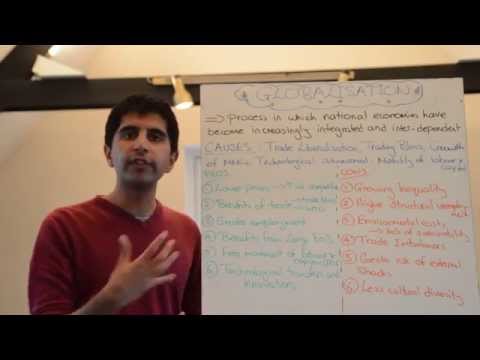 ▶ Topic lesson
A lesson on this topic · by EconplusDal. Tap the picture to open it on YouTube.
Solutions follow the official Cambridge mark schemes; marks are shown in grey. Videos are from other YouTube channels. Paper codes read component / series / year: M/J = May/June, O/N = October/November. Past-paper questions © UCLES, reproduced for classroom practice.