Q34 · 0455/21/M/J/21 Q5
Worked solution from the Government and the macroeconomy Theory (Paper 2) booklet, Part 4 of 8.

Worked solution
(a)
Write two industries from the primary sector (it takes things from the ground or sea). Any two of these:
Mining [1]
Fishing (or forestry, or oil extraction) [1]
(b)
Explain means: state the disadvantage, then say why it happens. Give two.
Disadvantage 1: a shortage of food (or famine). [1]
So the country may have to import more food (or export less), which worsens the current account. [1]
Disadvantage 2: economic growth / GDP falls. [1]
This happens if the lower farm output is not made up by a rise in output in the secondary and tertiary sectors. [1]
(Other accepted pairs: food prices rise → more poverty and worse health; less production → more unemployment; people move from rural to urban areas → pressure on city resources.)
(c)
Analyse means: give each step of the chain of reasoning and link them.
Deflation is a fall in the price level. [1]
The central bank could lower the rate of interest, which reduces the return from saving and encourages borrowing. [1]
People then spend more, so consumer expenditure rises. [1]
This increases total (aggregate) demand, [1]
so firms are able to raise their prices and the price level rises. [1]
Another way: it could increase the money supply, which raises bank lending and investment. [1]
(d)
Discuss means: explain why it should, explain why it might not, then decide.
Why it should: growth may increase market share and market power. [1]
It may increase profits and keep shareholders happy. [1]
It lets the firm take more advantage of economies of scale. [1]
It may raise the pay and job security of managers, and make the firm harder to take over because a bigger firm costs more to buy. [1]
Why it might not: if demand is falling, survival may be a better main objective. [1]
Profit maximisation, if it works, gives the funds for growth in the longer run. [1]
Growth may cause diseconomies of scale, or put pressure on workers, lowering productivity. [1]
Conclusion: it depends on the firm and whether demand is rising or falling. Growth is best when demand is rising and the firm can keep its costs under control; if demand is falling or the market is small, another objective such as survival is better. [1]
Official mark scheme

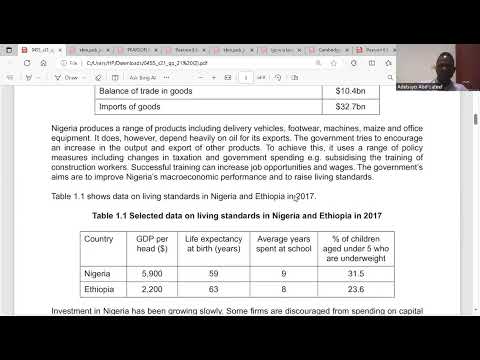 ▶ Whole paper
Video solution of the whole paper · by Adebayo Business 👨💼 Tutor (ABT). Tap the picture to open it on YouTube.
Solutions follow the official Cambridge mark schemes; marks are shown in grey. Videos are from other YouTube channels. Paper codes read component / series / year: M/J = May/June, O/N = October/November. Past-paper questions © UCLES, reproduced for classroom practice.