Q3 · 5070/21/O/N/23 Q7
Worked solution from the Experimental techniques and chemical analysis Theory (Paper 2) booklet, Part 1 of 2.

Worked solution
(a)
Find the moles of Ca(OH)2, use the equation to find moles of ethanoic acid, then divide by its volume.
Moles of Ca(OH)2 = 25.0 ÷ 1000 × 0.0100 = 2.5 × 10⁻⁴ mol [1]
From the equation, 2 acid : 1 Ca(OH)2, so moles of CH3COOH = 2 × 2.5 × 10−4 = 5 × 10⁻⁴ mol [1]
Concentration = 5 × 10⁻⁴ ÷ (12.5 ÷ 1000) = 0.0400 mol/dm3 [1]
(b)
Thymolphthalein is blue in alkali and colourless in acid.
Write blue. [1]
(c)(i)
A weak acid does not break up fully.
A weak acid is one that is incompletely ionised (dissociated) in aqueous solution. [1]
(c)(ii)
All acids make the same ion in water.
Write H+. [1]
(d)
Moles of Na2CO3, then use 1 mol of CO2 per 1 mol of Na2CO3, then multiply by 24 000 cm3.
Mr of Na2CO3 = 106. Moles = 3.18 ÷ 106 = 0.03 mol [1]
Moles of CO2 = 0.03 (1 : 1 ratio)
Volume of CO2 = 0.03 × 24 000 = 720 cm3 [1]
(e)(i)
Sulfur is found in fossil fuels.
Write burning fossil fuels (that contain sulfur compounds). [1]
(e)(ii)
Remove sulfur before or after burning.
Write flue-gas desulfurisation (or use low-sulfur fuels). [1]
(e)(iii)
Sulfur dioxide and oxygen make sulfur trioxide. Balance: 2SO2 + O2 ⇌ 2SO3.
Write 2SO3. [1]
Official mark scheme

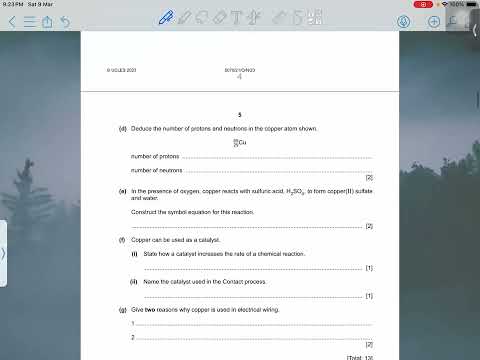 ▶ Whole paper
Video solution of the whole paper · by Dr Sajjad Haider. Tap the picture to open it on YouTube.
Solutions follow the official Cambridge mark schemes; marks are shown in grey. Videos are from other YouTube channels. Paper codes read component / series / year: M/J = May/June, O/N = October/November. Past-paper questions © UCLES, reproduced for classroom practice.