Q30 · 5090/21/O/N/21 Q3
Worked solution from the Coordination and control Theory (Paper 2) booklet, Part 5 of 6.

Worked solution
(a)(i)
Write any two of these.
Homeostasis is the maintenance of a constant internal environment (such as temperature). [1]
Evaporation of sweat removes heat and so cools the body, returning the temperature to normal (negative feedback). [1]
(a)(ii)
Write any four of these.
Receptors in the skin detect the rise in temperature. [1]
An impulse is sent to the brain / CNS. [1]
Vasodilation: the blood vessels (arterioles) widen, so more blood flows near the skin surface. [1]
So there is greater loss of heat by radiation. [1]
(b)
Write: liver. [1]
(c)(i)
Compare the table values for urine and blood plasma. Write any four of these.
Urea is higher in urine (393 mmol per dm3) than in blood plasma (6 mmol per dm3); there is less urea in blood plasma. [1]
Sodium is higher in blood plasma (141 mmol per dm3) than in urine (110 mmol per dm3). [1]
Chloride is lower in blood plasma (99 mmol per dm3) than in urine (103 mmol per dm3). [1]
Use a calculation too: urea in urine is 393 ÷ 6 = about 65 times higher than in plasma. [1]
(c)(ii)
The patient's kidneys do not work properly.
Urea concentration in the patient's sweat is higher (over 22 mmol per dm3). [1]
Because less urea is filtered / removed from the blood by the kidneys. [1]
So more urea stays in the blood plasma, and more passes into the sweat. [1]
Official mark scheme

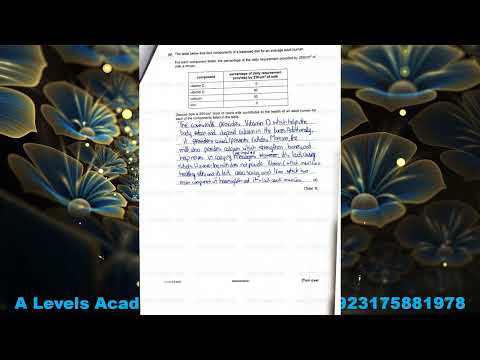 ▶ Whole paper
Video solution of the whole paper · by A Levels Academy Islamabad. Tap the picture to open it on YouTube.
Solutions follow the official Cambridge mark schemes; marks are shown in grey. Videos are from other YouTube channels. Paper codes read component / series / year: M/J = May/June, O/N = October/November. Past-paper questions © UCLES, reproduced for classroom practice.