Q7 · 9701/42/F/M/24 Q5
Worked solution from the Organic synthesis Theory (Paper 4) booklet, Part 1 of 1.

Worked solution
(a)(i)
The electrophile is made when AlCl3 removes Cl− from CH3Cl.
Write AlCl3 + CH3Cl → AlCl4− + CH3+. [1]
(a)(ii)
This is electrophilic substitution.
Draw a curly arrow from inside the benzene ring to the CH3+. [1]
Draw the intermediate: the ring with H and CH3 on the same carbon and a partial ring with a + charge. [1]
Draw a curly arrow from the C–H bond back into the ring, and show H+ as the product. [1]
(a)(iii)
The CH3 becomes CHO and water forms.
Write C6H4(Cl)CH3 + 2[O] → C6H4(Cl)CHO + H2O. [1]
(a)(iv)
Step 3 adds HCN to the aldehyde. Step 4 hydrolyses the nitrile to a carboxylic acid.
Step 3: HCN with a little KCN (or KCN with H2SO4 or HCl). [1]
Step 4: H2SO4(aq) or HCl(aq) (heat). [1]
(a)(v)
Acid plus methanol gives an ester. Write condensation (addition–elimination). [1]
(a)(vi)
A strong base such as NaOH would hydrolyse the ester group. [1]
(a)(vii)
Write: it can rotate the plane of plane-polarised light. [1]
(a)(viii)
Any two of these reasons, one mark each: the other enantiomer may have reduced or different biological activity; no need to separate the isomers afterwards; a lower dose is needed (more potent); a higher yield of the active molecule; fewer harmful side effects (the other isomer may cause side effects). [2]
(b)(i)
Aspirin is a weak acid, so use [H+] = √(Ka × [HA]).
[HA] = (0.075 ÷ 180) ÷ 0.100 = 4.17 × 10⁻³ mol dm−3 [1]
[H+] = √(10−3.49 × 4.17 × 10−3) = 1.16 × 10⁻³ mol dm−3 [1]
pH = −log(1.16 × 10⁻³) = 2.94 (2.93 to 2.94 accepted) [1]
(b)(ii)
Acid hydrolysis breaks the ester link.
Draw 2-hydroxybenzoic acid (salicylic acid): a ring with OH and CO2H next to each other. [1]
Draw ethanoic acid, CH3CO2H. [1]
Official mark scheme

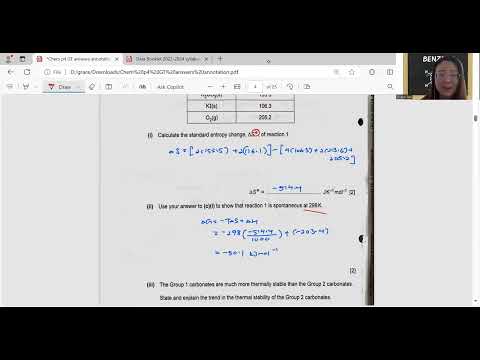 ▶ Starts at Q5 (57:54)
Starts at Q5 (57:54) · by GTChem. Tap the picture to open it on YouTube.
Solutions follow the official Cambridge mark schemes; marks are shown in grey. Videos are from other YouTube channels. Paper codes read component / series / year: M/J = May/June, O/N = October/November. Past-paper questions © UCLES, reproduced for classroom practice.