Q31 · 9700/42/F/M/20 Q6
Worked solution from the Classification, biodiversity and conservation Theory (Paper 4) booklet, Part 3 of 3.

Worked solution
(a)
Work down the ranks: domain, kingdom, phylum, class, order, family, genus, species.
The blank between phylum and order is class. [1]
The blank between order and genus is family. [1]
(b)
The 1000 survivors carried only a small part of the original gene pool. Write any three of these:
Low genetic variation (a small gene pool). [1]
Inbreeding depression (low hybrid vigour): matings between close relatives give weaker offspring. [1]
Low heterozygosity / high homozygosity: more individuals carry two copies of the same allele. [1]
Also accepted: more chance that harmful recessive alleles are expressed (come together); the gene pool may not be representative of the original population.
(c)
Use Fig. 6.3: sea otters eat sea urchins, starfish, molluscs and large fish (large fish eat crabs). Any change is fine if the reason fits the food web. Write one for each:
Sea urchins increase, because their predator, the sea otter, is absent. [1]
Animal plankton decrease, because molluscs eat them and the molluscs increase (no otters to eat them). [1]
Crabs decrease, because large fish eat crabs and large fish increase (no otters to eat them). [1]
(d)
The otter used anaerobic respiration, so lactate built up. Write any three of these:
The otter needs extra oxygen after the dive (an oxygen debt, EPOC). [1]
Lactate has built up in the muscles. [1]
Oxygen is needed to convert lactate to pyruvate / glycogen (not just 'break down lactate'). [1]
Also accepted: reoxygenation of haemoglobin / myoglobin; replenishing ATP.
(e)
Two proteins make up the filaments in a sarcomere: myosin and actin. Write any four of these:
Myosin is a fibrous protein. [1]
Myosin has globular heads with ATPase activity. [1]
Actin is a globular protein. [1]
Tropomyosin / troponin are also involved (they cover the binding site on actin). [1]
Also accepted: actin has a binding site for the myosin head; myosin is about 15 nm wide with M lines; actin is about 7 nm wide with Z lines.
Official mark scheme

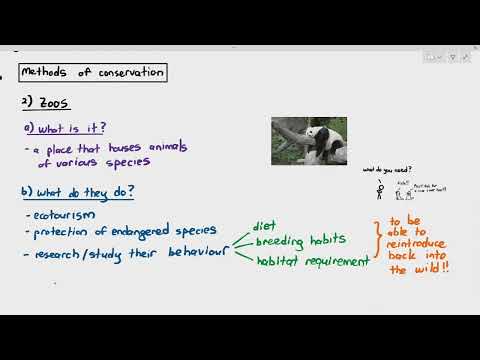 ▶ Topic lesson
A lesson on this topic · by OtterBioTutor. Tap the picture to open it on YouTube.
Solutions follow the official Cambridge mark schemes; marks are shown in grey. Videos are from other YouTube channels. Paper codes read component / series / year: M/J = May/June, O/N = October/November. Past-paper questions © UCLES, reproduced for classroom practice.