Q43 · 9708/23/O/N/23 Q4
Worked solution from the Government macroeconomic intervention Theory (Paper 2) booklet, Part 4 of 4.

Worked solution
(a)
Write the name of the country you know (for example, the one you studied) and apply each point to it.
Unemployment is when people able and willing to work and actively seeking a job cannot find one. [1]
Type 1: cyclical (demand-deficient) unemployment: caused by a fall in aggregate demand in a downturn, so firms produce less and lay off workers. [1]
Type 2: structural unemployment: caused by the decline of some industries or a mismatch of skills or location (occupational or geographical immobility), so workers cannot easily move into new jobs. [1]
Analyse each cause in your chosen country: say when it has happened there and who is affected, for example the workers in declining industries or during a recession. [1]
Say how serious each is: structural unemployment can be long-lasting and hard to solve, while cyclical unemployment falls when the economy recovers. [1]
Name the country clearly (without a named country, only 1 analysis mark is possible) and keep both types applied to it. [1]
Evaluation: compare the two and say which is most significant in your country, for example structural if it is long-term and hard to cure, and explain why. [1]
Give a justified conclusion naming the most significant cause. [1]
(b)
Explain what supply-side policy is: policies that increase the productive capacity of the economy (long-run aggregate supply), such as retraining and updating skills, information on job vacancies, and encouraging business start-ups.
Show how it reduces long-term unemployment: workers gain skills that match vacancies, so they find work, and new firms create jobs.
Advantages: it can be non-inflationary because it raises output capacity, and its effects are long-term.
Disadvantages: it can take a long time to work, has an opportunity cost (money spent on training cannot be used elsewhere), and depends on how receptive the workforce is. It may not suit every type of unemployment: for cyclical unemployment, demand-side policy is more suitable.
Alternative policy: expansionary fiscal policy (lower taxes or higher government spending) raises AD and creates jobs quickly, but it may cause inflation, raise the government's budget deficit, and does little for structural unemployment. Expansionary monetary policy (lower interest rates) has similar strengths and risks.
Evaluation: supply-side policy is not the only way: the best policy depends on the cause of the long-term unemployment, and a mix of policies is often best.
Conclusion: supply-side policy is the most suitable for long-term (structural) unemployment because it deals with its cause, but it is not the only way, as demand-side policy helps when demand is too low.
This reaches the top level for knowledge, understanding and analysis: detailed, accurate explanation of supply-side policy, its advantages and disadvantages, and an alternative policy, in a logical and well-organised answer. [8]
It reaches the top level for evaluation: a justified conclusion that answers the question, with developed and reasoned comments. [4]
Official mark scheme

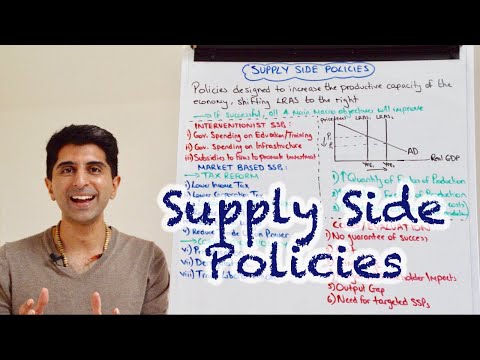 ▶ Topic lesson
A lesson on this topic · by EconplusDal. Tap the picture to open it on YouTube.
Solutions follow the official Cambridge mark schemes; marks are shown in grey. Videos are from other YouTube channels. Paper codes read component / series / year: M/J = May/June, O/N = October/November. Past-paper questions © UCLES, reproduced for classroom practice.