Q5 · 5090/21/M/J/23 Q2
Worked solution from the Relationships of organisms with one another and with the environment Theory (Paper 2) booklet, Part 1 of 5.

Worked solution
(a)(i)
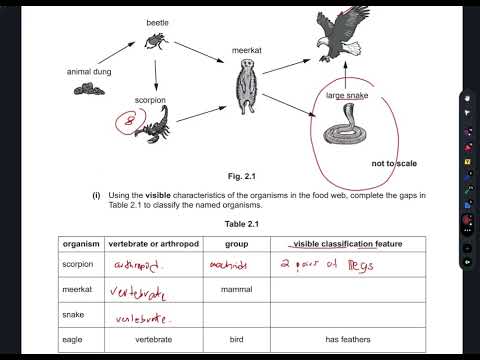
Look at the organism in the food web and use only what you can see. There are six marks, one for each correct group of answers.
First column: scorpion = arthropod, meerkat = vertebrate, snake = vertebrate. [1]
Second column: scorpion = arachnid. [1]
Second column: snake = reptile. [1]
Third column: scorpion = 8 legs (4 pairs of legs) (accept two parts to the body). [1]
Third column: meerkat = hair / fur. [1]
Third column: snake = scales. [1]
(a)(ii)
Follow the arrows: beetle → meerkat, meerkat → snake and eagle. Any four points score.
With fewer meerkats, there is less food available for snakes, so the number of snakes decreases. [2]
Eagles may eat more of the remaining meerkats (or more snakes) because fewer meerkats are available. [1]
Fewer meerkats means reduced predation on beetles, so the number of beetles increases. [1]
(a)(iii)
Think about the desert conditions in the question. Any two points score.
Deserts are dry and have high temperatures (harsh conditions). [1]
So few plants (producers) can grow, and plants and animals find it difficult to get enough water / not to lose too much water. [1]
(b)
Use the facts given: hot days, cold nights, open habitat. Any three points score.
The burrow keeps meerkats warm at night. [1]
It gives shelter / shade from the high midday temperatures and sunlight (or from sandstorms). [1]
Meerkats can hide from predators such as eagles and snakes. [1]
Also scores: a safe place to give birth / shelter young.
Official mark scheme

 ▶ Whole paper
Video solution of the whole paper · by Captain AB. Tap the picture to open it on YouTube.
Solutions follow the official Cambridge mark schemes; marks are shown in grey. Videos are from other YouTube channels. Paper codes read component / series / year: M/J = May/June, O/N = October/November. Past-paper questions © UCLES, reproduced for classroom practice.