Q22 · 9701/42/F/M/24 Q1
Worked solution from the Chemical energetics Theory (Paper 4) booklet, Part 2 of 4.

Worked solution
(a)(i)
Write: the enthalpy change when one mole of a substance (solute) dissolves in water to form an aqueous solution (at infinite dilution). [1]
(a)(ii)
A reaction can be spontaneous even if ΔH is positive, if the entropy gain is big enough.
There is a large increase in entropy (ΔS is positive, so TΔS is positive). [1]
So ΔG is negative because TΔS is bigger than ΔH. [1]
(b)(i)
Think about the charge density of the ion and how strongly it pulls on water.
The anionic charge density decreases from Cl– to I– (the ions get bigger). [1]
So there is less attraction between the ion and water (the ion–dipole force is weaker), and the hydration enthalpy is less exothermic. [1]
(b)(ii)
ΔHsol = ΔHhyd(K+) + ΔHhyd(X–) – ΔHlatt.
Write: the difference between ΔHlatt and ΔHhyd stays roughly constant, because both become less exothermic by a similar amount. [1]
(b)(iii)
ΔHsol = ΔHhyd(K+) + ΔHhyd(I–) – ΔHlatt
+21.0 = ΔHhyd(K+) + (–293) – (–629)
ΔHhyd(K+) = 21.0 + 293 – 629 = –315 kJ mol–1 [1]
(b)(iv)
PbI2(s) ⇌ Pb2+(aq) + 2I–(aq). Let solubility = x, so [Pb2+] = x and [I–] = 2x.
Ksp = x × (2x)2 = 4x3 = 7.1 × 10⁻⁹ [1]
x = ∛(7.1 × 10⁻⁹ / 4) = 1.21 × 10⁻³ mol dm–3 [1]
(b)(v)
Write: ΔHlatt of PbI2 is more exothermic (more negative) than that of KI.
Pb2+ has a greater charge than K+. [1]
Pb2+ is also smaller than K+ (0.120 nm against 0.133 nm), so there is greater attraction between Pb2+ and I– (a stronger ionic bond). [1]
Give all three points (greater charge, smaller radius, greater attraction). Together they earn the 2 marks.
(c)(i)
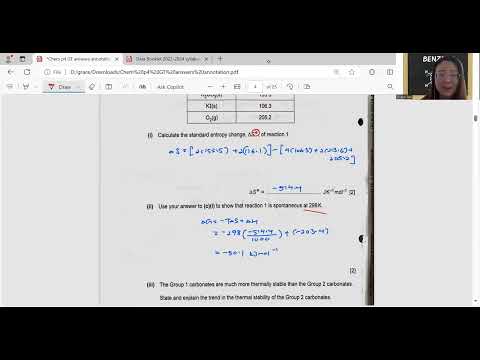
ΔS = ΣS(products) – ΣS(reactants)
ΔS = [2(155.5) + 2(116.1)] – [4(106.3) + 2(213.6) + 205.2] [1]
ΔS = 543.2 – 1057.6 = –514.4 J K–1 mol–1 [1]
(c)(ii)
ΔG = ΔH – TΔS, with T = 298 K. Change ΔS to kJ: –0.5144 kJ K–1 mol–1. [1]
ΔG = –203.4 – 298 × (–0.5144) = –203.4 + 153.3 = –50.1 kJ mol–1 (–50.2 also accepted). ΔG is negative, so the reaction is spontaneous. [1]
(c)(iii)
Write: the thermal stability increases down the group. [1]
The cation radius increases, so there is less polarisation (distortion) of the carbonate ion and the C–O bond is less weakened. [1]
(d)(i)
Cathode: reduction. In KI(aq) the H+ from water is reduced to hydrogen.
2H+(aq) + 2e– → H2(g) [1]
(d)(ii)
moles S2O32– = 21.35 / 1000 × 0.100 = 2.135 × 10⁻³ mol [1]
From the equation, moles I2 = ½ × 2.135 × 10–3 = 1.0675 × 10⁻³ mol
Charge Q = 2.135 × 10⁻³ × ½ × 2 × 96500 = 206 C (2 electrons per I2) [1]
Time = 8 × 60 = 480 s
I = Q / t = 206 / 480 = 0.429 A (0.428 A also accepted) [1]
(e)(i)
Step 1 turns benzene into nitrobenzene (nitration). Step 2 turns the nitro group into an amine (reduction).
Step 1: concentrated HNO3 and concentrated H2SO4. [1]
Step 2: Sn and (concentrated) HCl. [1]
(e)(ii)
Stage I is an acid–base reaction between NaNO2 and HCl.
stage I: NaNO2 + HCl → HNO2 + NaCl [1]
stage II: C6H5NH2 + HNO2 + H+ → C6H5N2+ + 2H2O [1]
(e)(iii)
The I– ion attacks the ring carbon and replaces N2.
Write: nucleophilic (aromatic) substitution. [1]
Official mark scheme

 ▶ Starts at Q1 (0:57)
Starts at Q1 (0:57) · by GTChem. Tap the picture to open it on YouTube.
Solutions follow the official Cambridge mark schemes; marks are shown in grey. Videos are from other YouTube channels. Paper codes read component / series / year: M/J = May/June, O/N = October/November. Past-paper questions © UCLES, reproduced for classroom practice.