Q17 · 5070/21/O/N/23 Q2
Worked solution from the The Periodic Table Theory (Paper 2) booklet, Part 4 of 5.

Worked solution
(a)
Group I metals are soft, light and melt easily. Copper is hard, dense and has a high melting point.
Write any two of: potassium has a lower density; a lower melting point; is softer; is grey / silvery (copper is pink / orange). [2]
(b)
Potassium has 19 electrons. It loses 1 to form K+, leaving 18 electrons.
The shells are filled 2, 8, 8. Draw 2 electrons in the first shell, 8 in the second and 8 in the third. [1]
Write + (a single positive charge) at the top right of the brackets. [1]
(c)
The faster the bubbles, the more reactive the metal.
Write: vanadium, uranium, cerium, potassium (least reactive first). [1]
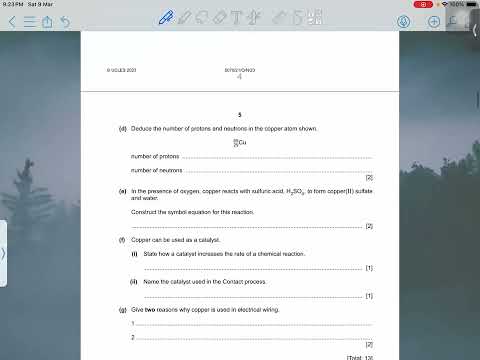
(d)
Number of protons = the bottom number. Neutrons = top number − bottom number.
protons = 29 [1]
neutrons = 65 − 29 = 36 [1]
(e)
Reactants: Cu, H2SO4 and O2. Products: CuSO4 and H2O.
Correct formulae are needed first. [1]
Balance: 2Cu + 2H2SO4 + O2 → 2CuSO4 + 2H2O. Check: 2 Cu, 2 S, 10 O and 4 H on each side. [1]
(f)(i)
A catalyst gives the reaction an easier path.
Write that it lowers the activation energy of the reaction. [1]
(f)(ii)
Write vanadium(V) oxide. [1]
(g)
Think about what wires must do: carry current and be pulled into thin shapes.
Write good electrical conductivity. [1]
Write that it is (very) ductile. [1]
Official mark scheme

 ▶ Whole paper
Video solution of the whole paper · by Dr Sajjad Haider. Tap the picture to open it on YouTube.
Solutions follow the official Cambridge mark schemes; marks are shown in grey. Videos are from other YouTube channels. Paper codes read component / series / year: M/J = May/June, O/N = October/November. Past-paper questions © UCLES, reproduced for classroom practice.